Let me set the tone for this thread upfront.
This is not a “Sellvia support is terrible, avoid at all costs” post. It’s also not a “support is amazing and anyone who complains just didn’t try hard enough” post.
It’s an honest attempt to map out what Sellvia support actually looks like in practice - when it works well, when it doesn’t, what to expect at different stages, and most importantly what to do when you’re not getting the resolution you need.
Because support experiences vary wildly on this platform and I think the variance itself is worth understanding. The same platform that resolves one person’s issue in four hours leaves another person waiting three days for a meaningful response. Understanding why that happens is more useful than just collecting complaints or defenses.
So let’s get into it. 
 What support channels actually exist
Before talking about experiences let’s establish what you’re actually working with when you need help.
Live chat is the primary support channel and the fastest one when it’s staffed properly. You’ll find it through the Support section in your left menu or through the chat bubble that appears on most pages. Response times vary significantly - during peak hours you can get a response in minutes, during off-peak hours you might wait considerably longer before anyone picks up.
Email/ticket system is the backup channel for more complex issues. Response times here are measured in hours to days rather than minutes. The upside is you have a written record of everything which matters when you’re dealing with a multi-step issue that requires follow-up.
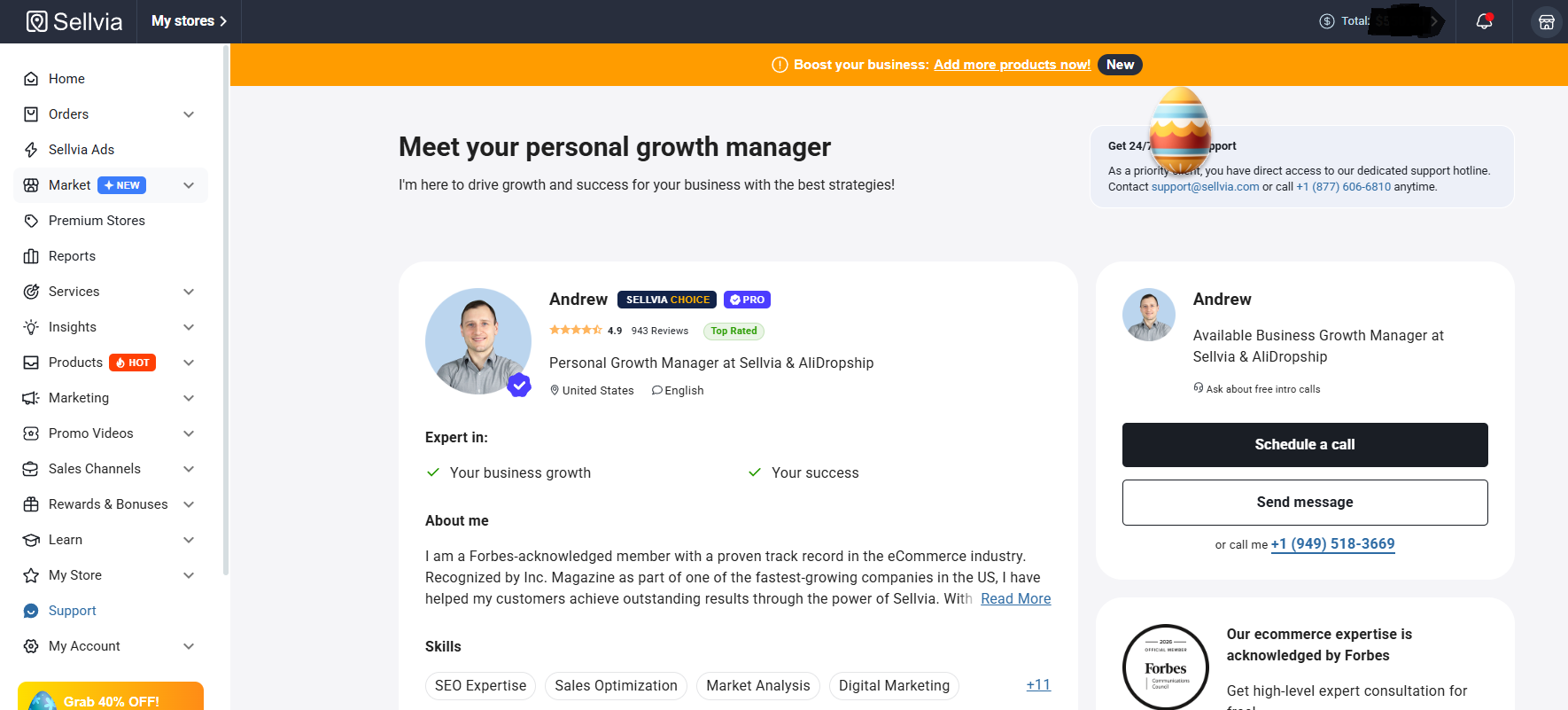
Growth manager via SMS is something many users have access to especially during and after the trial period. This is a direct line to a real person who can often escalate issues faster than going through the standard support queue. If you have a growth manager assigned to your account - use them for support escalation. They’re often more responsive than the general support queue.
Help center / documentation covers the basics and is genuinely useful for common setup questions. Less useful for account-specific issues or edge cases.
 When Sellvia support works well
Let’s start here because the failure modes are more interesting when you understand what good looks like.
Support tends to work well for straightforward, well-defined issues. Things like:
Subscription billing questions. If you don’t understand why a charge appeared or want to confirm what your subscription includes - support handles these quickly and clearly in most cases.
Basic platform navigation. Questions about where to find a specific feature, how to add products, how to access a particular section of the dashboard - generally resolved fast.
Order status questions. If you have a specific order ID and a specific question about its status - support can look it up and give you a direct answer.
Technical issues with the platform itself. If something isn’t loading or a feature isn’t behaving as expected - these get flagged and usually resolved within a reasonable timeframe.
The pattern here is clear. Simple, specific, lookup-based questions get good support responses. The problems start when the issue is more complex, more ambiguous, or requires actual judgment rather than information retrieval.
 Where support tends to fall short
This is the honest part. And it’s worth saying clearly because these patterns show up repeatedly across user experiences.
Response time inconsistency is the most common complaint and it’s legitimate. The gap between best-case and worst-case response times is wide. Getting a response in 20 minutes on a Monday afternoon and waiting 18 hours for a response on a Saturday night are both real experiences on the same platform. If you have a time-sensitive issue - an order that needs processing, a billing question that’s blocking you - the unpredictability of response time is genuinely frustrating.
Templated first responses are a real thing. Many users report that their first reply from support feels like a copy-paste answer that addresses the general category of their question without actually addressing the specific details they provided. You write three paragraphs explaining your exact situation and get back a response that links to a help article about the general topic. It’s not wrong exactly - it’s just not responsive to what you actually asked. You then have to reply again with “I’ve already read that, my specific question is…” and wait for another response.
Escalation difficulty is where things get most frustrating. For issues that require a decision beyond what a front-line support agent can make - account reviews, unusual commission questions, billing disputes - getting to someone who can actually resolve the issue takes persistence. First response is often a front-line agent who can only do so much. Getting escalated to someone with more authority requires follow-up and patience that not everyone has.
Commission and payment questions specifically seem to take longer than other categories. These are the questions with the highest emotional stakes - people waiting for their first withdrawal, confused about why their available balance doesn’t match their total balance, dealing with a reversed commission from a refund. These need clear, specific answers quickly. The support response on these is more variable than it should be.

 How to get better support results - practical tactics
This section is the most practically useful part of the post because complaining about support quality doesn’t help you resolve your issue. Knowing how to navigate it does.
Be specific from the first message. Don’t say “I have a problem with my order.” Say “Order ID CUR-XXXXXXXX placed on April 5th shows as processed in my dashboard but the commission hasn’t appeared in my Sellvia Payments balance after 48 hours. Can you confirm the commission was credited and if not what’s causing the delay?” The more specific your first message the more specific the first response. Vague questions get generic answers.
Include your order IDs, dates, and dollar amounts. Support agents are looking at your account while responding. The faster they can find the specific transaction you’re asking about the faster they can give you a useful answer. Make their job easy and they’ll resolve your issue faster.
Follow up politely but consistently. If your first response was templated and didn’t address your actual question - reply the same day. Don’t wait 24 hours before following up. Say specifically what the response didn’t address and restate your actual question. Polite persistence gets results faster than frustrated escalation.
Use your growth manager for escalation. If you have a growth manager contact via SMS - use them for issues that the regular support queue isn’t resolving fast enough. They have different access and different incentives than front-line support agents. A growth manager who wants to keep you as a customer will often find ways to move your issue forward faster than the standard queue.
Document everything in writing. For any issue involving money - commissions, billing, refunds - make sure your communication is in writing either via chat (screenshot everything) or email. If an issue escalates you want a paper trail that shows exactly what was said and when.
Time your contact strategically. If you know you’ll need support for something time-sensitive - contact during business hours on weekdays. Weekend and late-night support is thinner and response times are longer. For urgent issues during off-hours use the chat and leave your message even if nobody responds immediately - you’ll be in the queue when the team comes online.
 The growth manager experience - a separate conversation
The growth manager system deserves its own mention because it operates differently from standard support and the experiences are different enough to discuss separately.
Growth managers reach out via SMS during and after the trial period. For many users this is the most responsive and most helpful human contact they have with the platform. A good growth manager answers questions quickly, helps troubleshoot early issues, and can escalate platform problems faster than the general support queue.
The variable here is which growth manager you get and how active they are. Some users report their growth manager being genuinely helpful throughout their first few months. Others report that contact faded after the initial trial period and attempts to reach them later went unanswered.
If your growth manager is responsive - treat them as your primary support channel for anything that matters. If they’ve gone quiet - the standard support channels are your path forward.
 The honest perspective on what support can and can’t do
Here’s the frame I’ve come to after being on this platform long enough to have needed support multiple times.
Sellvia support is adequate for a platform at this price point and customer volume. It’s not premium. It’s not the kind of concierge support you’d get from an enterprise software company charging thousands per month. It’s the kind of support you get from a $39/month SaaS platform serving hundreds of thousands of users - functional, inconsistent, better when you know how to use it.
The frustration most people feel with Sellvia support isn’t that the support team is bad. It’s that the issues people need support for - commission questions, billing disputes, first withdrawal anxiety - are high stakes emotionally even when they’re not complicated operationally. Waiting 12 hours for a response about money you’re expecting feels a lot worse than waiting 12 hours for a response about a feature you’re curious about.
Managing your expectations about response time while also knowing how to advocate clearly for yourself is the combination that gets issues resolved. Neither alone is enough.
The things I genuinely wish were better 
Being honest - there are specific things about Sellvia support that I think are legitimately worth improving and worth saying out loud.
Faster response on financial questions. When someone’s commission is delayed or their withdrawal is blocked that needs to be a priority queue not a standard queue. Money questions are not equal to navigation questions.
Less templating on first responses. A first response that acknowledges the specific details of what was asked rather than addressing the general category would save everyone a round of back-and-forth.
Clearer communication about timelines. “We’re looking into this” is not useful. “We’re looking into this and will have an answer within 24 hours” is. Setting expectations proactively would reduce the follow-up burden on both sides.
More consistent growth manager availability. The growth manager system is genuinely valuable when it’s working. Making it more consistently available beyond the trial period would improve the support experience significantly for users who are past the initial onboarding phase.
Drop your experience below
What’s been your best support experience on Sellvia - what made it work?
What’s been your worst - and how did it eventually get resolved? 
Any specific tactics you’ve found that get faster or better responses?
And for anyone dealing with a support issue right now - describe it below and let the thread help troubleshoot
Real experiences in both directions welcome. The honest ones are the most useful.
