Everything else varies - niche, products, budget, timeline, experience level. But every single store on this platform lives or dies based on the same variable: are real people landing on it every day, and are enough of those people buying something?
The good news is Sellvia’s built-in advertising system removes the steepest part of the learning curve for most beginners. The even better news is that paid traffic is only one of several channels that actually work for this model - and the most profitable stores almost always have two or three of them running simultaneously.
I’ve been running my store for twelve months. I’ve tested every traffic channel I could find discussed in forums, Sellvia reviews, and ecommerce communities. Some worked. Some didn’t. Some worked eventually after I stopped expecting them to work immediately.
This is the complete breakdown. Every channel, honest results, what it actually takes to make each one work. 
Channel 1 - Sellvia Ads: the starting point everyone should use
Let’s start here because it’s where almost every successful Sellvia store starts and because understanding how it works changes how you use it.
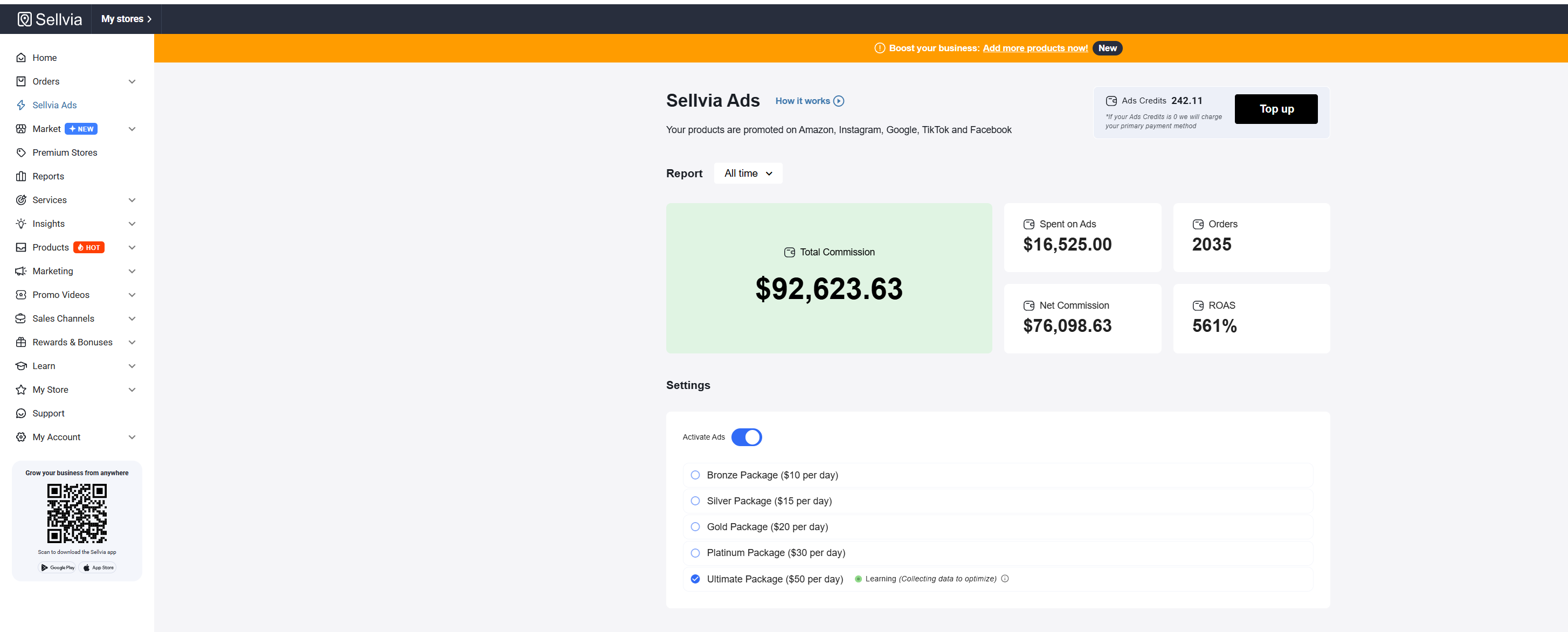
Sellvia Ads is a managed advertising system that runs your store across Google, Facebook, TikTok, and Instagram simultaneously. You choose a daily budget - Bronze at $10/day, Silver at $15/day, Gold at $20/day, Platinum at $30/day, Ultimate at $50/day - and the system handles everything else. Audience targeting, creative delivery, placement optimization, bid management. You see traffic and orders in your dashboard. You don’t see what’s happening underneath.
The part most beginners don’t understand going in: the system has a learning phase that typically runs seven to fourteen days. During this phase the algorithm is collecting data about which audiences respond to your store, which placements convert, what time of day your traffic buys. Results during this phase are worse than they’ll be after it. CPA is higher. Order volume is lower. This is normal and it ends.
The single most important thing you can do with Sellvia Ads: leave it alone during the learning phase. Don’t change the budget. Don’t swap products. Don’t pause and restart. Every interruption partially resets the optimization the system has built. The stores with the best paid traffic economics are almost always the ones that ran their original setup untouched for at least twenty-one days before making any adjustments.
Realistic results at $15/day: First sale typically days 5-21. CPA starts high ($14-20 range) and drops over time to $6-10 range by month three for a well-optimized store in a focused niche. Monthly ad spend: $450. Monthly commission income at optimized stage: $600-1,200 for stores with solid product selection.
Who it’s best for: Everyone, but especially beginners with no prior marketing experience. The managed system is what makes this model accessible to people who have never run advertising before.
Channel 2 - Organic TikTok: slow start, compounding returns
TikTok organic is the traffic channel most talked about and most misunderstood in ecommerce communities. Let me be specific about what it actually produces for Sellvia stores specifically.
The format that works for digital product stores on TikTok: problem-solution content. Not product showcases. Not “look what I found” hauls. Problem-solution content that addresses a specific pain your audience has - financial stress, disorganization, lack of direction, low productivity - and positions a digital product as the mechanism of change. The product appears naturally in the content rather than being advertised directly.
What it takes to make organic TikTok work: minimum three posts per week for ninety days before drawing any conclusions about whether it’s working. The algorithm takes time to understand your content category and distribute it to the right audience. Most people quit at week four when the views are still low. The stores that push through to week twelve are the ones who discover that one video from month two is still driving traffic in month five.
The compounding nature of TikTok organic is what makes it worth building even when the early results are discouraging. A video that performs well keeps driving traffic indefinitely. Your month three content library is working for you in month nine. Paid ads stop the moment you stop paying. Organic content accumulates.
Realistic results: Zero meaningful traffic for weeks one through four. First consistent traffic from organic TikTok typically arrives in month two for people posting three-plus times per week. By month four to six, a store with consistent content can see organic contributing 15-25% of total traffic. Cost: your time. Return per hour invested: higher than paid traffic once it’s established.
Who it’s best for: People comfortable on camera or willing to develop that comfort. People with patience for a sixty to ninety day ramp-up period. Anyone trying to reduce dependence on paid advertising over time.
Channel 3 - Pinterest: the underrated long game
Pinterest gets dismissed constantly in ecommerce discussions and it shouldn’t - at least not for the product categories that dominate Sellvia’s catalog.
Personal finance, home organization, health and wellness, personal development, family and parenting - these are Pinterest’s strongest performing content categories. They’re also where Sellvia’s digital product catalog is deepest. The audience overlap is not coincidental. The people who search Pinterest for home organization ideas are the people most likely to buy a home organization guide from a store they discover through a well-optimized pin.
Pinterest works differently from TikTok. It’s a search engine, not a social feed. People come to Pinterest with specific intent - they’re searching for something specific and ready to engage with content that matches what they’re looking for. A well-optimized pin with strong keywords in the description can rank for a search term and drive consistent traffic for months or years after it was posted.
The setup that produces results: ten to fifteen pins per week minimum, consistently, for sixty days before expecting meaningful traffic. Each pin should have a keyword-rich description targeting a specific search term your audience uses. Link directly to the relevant product page in your store, not your homepage. The conversion path from Pinterest click to purchase is most effective when it’s as short as possible.
Realistic results: Minimal traffic for weeks one through eight. First consistent organic search traffic typically arrives around week ten to twelve for accounts posting consistently. By month six, a well-maintained Pinterest presence can drive two hundred to five hundred visitors per month at zero ongoing cost. Individual strong pins can drive traffic for years.
Who it’s best for: Stores in visual niches - home, health, personal finance, lifestyle. Anyone willing to build a slow but permanent traffic source. People who prefer writing and imagery over video content.
Channel 4 - Email marketing: the traffic you already own
Technically email isn’t a traffic channel in the traditional sense - it’s more accurate to call it a reactivation channel. But the effect on your store’s revenue is identical to any traffic source: more people landing on your store with a reason to buy.
The distinction that makes email different from every other channel: you already paid to acquire these people. Every subscriber on your list came from a store visit you paid for through Sellvia Ads or organic content. Sending them an email that generates a purchase costs you essentially nothing. The return on that near-zero cost is the highest of any channel you’ll run.
The three automations that do most of the work have been discussed extensively in other threads on this forum. Welcome sequence for new subscribers. Post-purchase follow-up with related products. Re-engagement sequence for subscribers who haven’t opened in thirty to forty-five days. Set these up once in month one and they run indefinitely.
What most Sellvia reviews don’t emphasize enough about email: the conversion rate difference between cold paid traffic and warm email traffic is typically four to six times. A cold visitor from your Sellvia Ads converts at one to three percent. A past buyer receiving a relevant email converts at eight to fifteen percent. The email list isn’t a nice-to-have that you add later. It’s the highest-ROI asset in your entire marketing stack and it gets more valuable every month you build it.
Realistic results: First email-driven sales typically appear in month two once you have enough subscribers to generate meaningful volume. By month five with a list of two to three hundred subscribers, email typically contributes ten to twenty percent of monthly orders at near-zero acquisition cost.
Who it’s best for: Everyone, from day one. There is no stage at which building an email list is the wrong move. The only wrong move is delaying it.
Channel 5 - SEO and organic Google traffic: the longest game with the best returns
Organic search traffic from Google is the most durable traffic source available to any online store. It’s also the slowest to build and the one most beginners deprioritize in favor of channels that produce faster feedback.
For Sellvia stores specifically, SEO works best in two forms. The platform’s built-in SEO package optimizes your store’s product pages and metadata to rank for relevant search terms - this is the passive version that requires minimal ongoing effort. The active version involves creating original content - blog posts, guides, resource pages - on your store’s domain that target high-intent keywords your audience searches for.
The SEO package timeline: expect eight to twelve weeks before organic search traffic becomes visible in your analytics. By month six for stores that started SEO early, organic typically represents fifteen to twenty-five percent of total traffic. That percentage grows every month as rankings mature. The traffic is free, permanent, and gets more valuable over time.
The content-driven SEO timeline is longer - three to six months before meaningful ranking - but the ceiling is higher. A blog post that ranks for “best budgeting guide for beginners” and drives three hundred visitors per month to your store is a traffic asset that pays indefinitely with no ongoing cost after the initial creation.
Realistic results: Invisible for the first sixty days. Meaningful contribution by month four to six. By month nine to twelve for stores with consistent content, organic search can represent twenty to thirty percent of total traffic. At that point your blended cost per acquired sale across all channels drops significantly.
Who it’s best for: Anyone building for the long term. Anyone who wants to reduce paid traffic dependence. Anyone willing to invest time in content that compounds over months and years.
The traffic stack that actually works long term
Here’s the pattern that shows up consistently in the stores doing best on this platform after month six. Not just one channel. A stack of two to three channels that reinforce each other.
Months 1-2: Sellvia Ads only. Get the algorithm learning, get the first sales, prove the model works. Don’t split focus across channels while the core paid traffic system is still optimizing.
Month 2-3: Add email. Set up the three core automations. Add email capture to your store. Start building the list that will reduce your dependence on paid traffic over time. This costs almost nothing in time and money and starts compounding immediately.
Month 3-4: Add one organic channel. Pick the one that matches your niche and your content comfort zone. Pinterest for visual niches with strong search intent. TikTok for niches where short video content resonates. Commit to ninety days of consistent posting before evaluating results.
Month 4-6: Start SEO if you haven’t already. Either through the platform’s SEO package or through original content on your store’s domain. The earlier you start the earlier it contributes. Every month of delay is a month of organic compounding you don’t get back.
Month 6+: Evaluate which channels are contributing and scale what’s working. The email list should be generating meaningful repeat buyer volume. Organic should be visible in analytics. Paid ads should have a mature algorithm with CPA significantly below month one levels. At this point scaling ad spend produces better returns than it did in month one because everything else in the system is more efficient.
The honest bottom line on traffic
Traffic is not a solved problem on any platform. It’s an ongoing operational challenge that requires consistent attention and willingness to build channels that take months to produce meaningful results.
What makes Sellvia’s model more manageable than most: the built-in advertising system handles the hardest part of paid traffic without requiring you to develop advertising expertise first. That’s a real and meaningful advantage for beginners. But it’s not a complete solution - it’s a starting point.
The stores that generate the best long-term results on Sellvia are the ones that treat the built-in ads as a foundation, not a ceiling. They use Sellvia Ads to get to first revenue and first optimization. They build email lists to reduce their cost per repeat sale. They add one organic channel to create traffic that doesn’t require daily spend. They start SEO to build the permanent layer that compounds indefinitely.
None of those additional channels are optional for serious long-term growth. All of them take longer to show results than most beginners expect. And all of them become more valuable every month you build them consistently.
The stores that are still running profitably at month twelve almost always have at least two or three of these channels working together. The stores that are gone by month four almost always had only one. 
Drop your experience below
Which traffic channel has produced the best results for your Sellvia store - and when did it start contributing meaningfully?
Has anyone built a real organic Pinterest or TikTok presence alongside their store? What does the traffic actually look like after six months?
And for anyone just starting - which channel feels most approachable for where you are right now?
 You describe email as a “reactivation channel” which is technically accurate but undersells what it actually does for your economics. At month eight my email list of 380 subscribers generates 22% of my monthly orders. Those orders have a blended acquisition cost of about $0.40 per sale - the monthly email tool cost divided by email-driven orders. Compare that to my paid traffic CPA of $7.20. The email channel isn’t just reactivating people. It’s generating sales at one-eighteenth the cost of my cheapest paid traffic source. That math compounds every month the list grows.
 People hear “build an email list” and think it’s generic advice. “$0.40 per sale vs $7.20 per sale for the same product” is not generic advice. That’s a specific number that makes the decision obvious. Why would you not build the channel that generates sales at one-eighteenth the cost of your current best alternative?
 That’s not twelve hours per month. That’s twelve hours total investment now generating passive monthly revenue. No equivalent exists in paid advertising at any budget level. You can’t buy that durability. You can only build it. The people dismissing Pinterest as “too slow” are comparing it to paid ads on a weekly timeline when the correct comparison is on a multi-year return basis.
 Instagram organic. I spent three months posting consistently on Instagram in my personal finance niche. The organic reach on Instagram in 2026 for a new account with no followers is essentially zero unless you’re running paid promotion. The algorithm heavily suppresses non-promoted content from accounts without established followings. TikTok still has meaningful organic reach for new accounts. Instagram does not. Anyone reading this and considering Instagram organic for their first traffic channel - redirect that effort to TikTok or Pinterest. The organic reach differential is significant.
 The Instagram organic reach point is accurate and important. Three months wasted is the cost of learning it the hard way. What’s interesting is that Instagram paid traffic through Sellvia Ads works fine - the built-in system uses Instagram as a placement and it converts. But self-managed organic Instagram for a new account with no existing following is genuinely not worth the time investment in 2026. TikTok or Pinterest for organic. Instagram through Sellvia Ads for paid. Those are the right channels for each approach.
 The mistake I see constantly is people trying to run all five channels simultaneously from day one and doing all of them poorly. Month one focus should be one hundred percent on Sellvia Ads because that’s what generates the data and the revenue that funds everything else. Email in month two because it’s the highest ROI next step. One organic channel in month three because you now understand your niche well enough to create relevant content. SEO in month four because you now have enough store history and product pages worth optimizing. The sequencing matters as much as the channels.
 I was trying to do paid ads plus TikTok plus Pinterest plus email simultaneously from week one. Zero of them were done well. By the time I was on attempt three and focused only on Sellvia Ads for the first thirty days I finally had enough data to understand my niche, understand my audience, and understand what content would actually resonate. The channels I added in month two and three were dramatically more effective because I built them on top of real knowledge about what was converting. Sequence first. Diversify second.
 That’s a 35% reduction in cost per acquired sale without reducing ad spend or changing products. The extra $143 per month in profit didn’t require more work - it required building the email and Pinterest channels that were doing their job quietly in the background while Sellvia Ads did the heavy lifting. Saving this comment to re-read every time I think about skipping the organic channel work.
 Posted consistently three times a week from month two. First video to break 10,000 views: day 51. First sale attributed directly to TikTok organic: day 63. Current monthly TikTok-driven traffic: approximately 280-340 unique visitors. Conversion rate from TikTok traffic: 1.4% - lower than Pinterest’s 2.8% but the volume is higher and the audience is younger and more engaged. The content format that performs consistently: thirty to forty-five second videos showing the problem the product solves, not the product itself. Never once shown a product page in a TikTok. Always shown the outcome the product creates.
 Sellvia Ads: $7.40 CPA. Pinterest organic: $0.85 CPA (tool cost divided by orders). Email: $0.40 CPA. YouTube Shorts: $0 CPA currently, too low volume to calculate. Total blended: $4.80 CPA. The weighted average is pulled down by the zero and near-zero cost channels. Every percentage point of traffic that shifts from paid to organic or email reduces my blended CPA further. This is the math that makes channel diversification not just a nice-to-have but a genuine profit lever.