Let me say upfront what most comparison posts won’t.
Both of these models have real risk. Neither is safe in the “put money in, get money back guaranteed” sense. Anyone who tells you otherwise is selling something.
But risk isn’t binary. It’s not “risky vs safe.” It’s specific types of risk at specific amounts at specific stages. And when you map out those specifics side by side - Sellvia and Amazon FBA look very different from each other in ways that matter enormously depending on where you’re starting from.
This post is that map. Every major risk category. Both platforms. Honest numbers where possible. No platform loyalty in either direction. 
 First - what are we actually comparing
Before comparing risks it’s worth being precise about what each model actually is because the operational differences between them shape every risk that follows.
Sellvia is a SaaS platform where you get a ready-built online store with a catalog of digital products - guides, courses, checklists, tools. Built-in advertising system handles your marketing. You earn commissions on each sale after paying the product cost. $39/month subscription. Digital products deliver instantly with no logistics involved.
Amazon FBA (Fulfillment by Amazon) means you source physical products - usually from manufacturers or wholesalers - send inventory to Amazon’s fulfillment centers, and Amazon handles storage and shipping when orders come in. You pay for inventory upfront, storage fees, fulfillment fees, and Amazon’s referral fees on every sale. You keep what’s left.
These are fundamentally different business models and the risks they carry reflect those differences. Let’s go through them category by category.
 Risk Category 1 - Upfront capital requirement
This is where the gap between these two models is most dramatic and most immediately relevant for beginners.
Sellvia:
Subscription: $39/month after 14-day free trial
Processing balance: $50-200 (working capital, not permanently spent)
Ad spend: $10-50/day (variable, can pause anytime)
Minimum to start seriously: $500-800
Amazon FBA:
Product sourcing (minimum viable inventory): $500-2,000+
Amazon Professional seller account: $39.99/month
UPC codes for your products: $30-250
Product photography: $100-500
FBA prep and shipping to Amazon: $100-500
Amazon PPC advertising to launch: $500-1,500
Minimum to start seriously: $3,000-5,000+
The capital gap is not small. A typical Amazon FBA launch requires 4-6x more upfront capital than a Sellvia start at comparable seriousness levels. And the critical difference - Amazon FBA capital is largely committed before you make a single sale. You buy inventory, ship it to Amazon, and then hope it sells. Sellvia capital is mostly variable - you pay as orders come in and can pause or adjust at any time.
Risk verdict: Sellvia significantly lower capital risk. 
 Risk Category 2 - Inventory risk
This category doesn’t exist for Sellvia. That’s the entire point.
Sellvia:
Zero inventory risk. The products are digital. They don’t exist physically. You can’t over-order them. They can’t sit unsold in a warehouse costing you storage fees. They can’t get damaged in transit. They can’t be stranded at a port. When demand for a product drops you simply remove it from your store. No sunk cost. No liquidation problem.
Amazon FBA:
Inventory risk is one of the most significant and least discussed risks in the FBA model. Here’s what it looks like in practice:
You order 500 units of a product at $8 each - $4,000 committed. The product arrives at Amazon. You launch with PPC ads. Three scenarios:
Scenario A - it sells well. Great. You reorder. But now you need more capital to reorder before you run out of stock or you lose your ranking.
Scenario B - it sells slowly. Your inventory sits in Amazon’s fulfillment centers accruing monthly storage fees ($0.75-2.40 per cubic foot depending on season). After 365 days slow-moving inventory incurs long-term storage fees. You’re paying to store something that isn’t selling.
Scenario C - a competitor undercuts your price or Amazon starts selling the same product. Your sales drop. You’re stuck with inventory you either sell at a loss, pay to have returned, or pay Amazon to dispose of.
None of these scenarios exist in the Sellvia model.
Risk verdict: Sellvia zero inventory risk vs FBA significant inventory risk.

 Risk Category 3 - Marketing and advertising risk
Both models require advertising to generate sales. The risk profiles are completely different.
Sellvia:
The built-in Sellvia Ads system handles targeting, creatives, and optimization for you. You set a daily budget between $10 and $50, turn it on, and the system runs. You don’t need to understand campaign structure, bidding strategies, or audience segmentation. The advertising risk is primarily budget risk - you spend money before you make money - but the complexity risk is removed. Even someone with zero marketing experience can run Sellvia Ads.
The floor for advertising failure on Sellvia: you spend $200-300 testing and don’t find a winning product-audience combination. That’s the worst case scenario in the early stage.
Amazon FBA:
Amazon PPC (Pay Per Click) is one of the most competitive advertising environments that exists in ecommerce. You’re bidding against established sellers with years of campaign data, massive review counts, and optimized listings. A new seller entering a competitive category can burn through $1,000+ in PPC spend during the launch phase before getting enough reviews and ranking to compete organically.
And unlike Sellvia Ads where the system optimizes itself, Amazon PPC requires active management. Keyword research. Bid optimization. Campaign structure decisions. Negative keyword lists. Match type strategy. Each of these is a real skill that takes months to develop. Running it badly doesn’t just mean lower returns - it means spending significant money with minimal results while your inventory sits and your storage fees accumulate.
Risk verdict: Sellvia significantly lower advertising risk.
 Risk Category 4 - Platform dependency risk
This is the risk category where Amazon FBA has a genuinely frightening track record.
Sellvia:
You operate within Sellvia’s ecosystem. If Sellvia changes its terms, adjusts its commission structure, or in an extreme scenario shuts down - you lose access to the platform and your store. That’s real platform risk. But your financial exposure is limited to your current month’s subscription and ad spend. You haven’t committed inventory. You haven’t built a business that depends on a specific algorithm ranking your products. The worst case exit from Sellvia costs you one month of operating costs.
Amazon FBA:
Amazon platform risk is a well-documented and serious phenomenon. Amazon can and does:
Suspend seller accounts with little warning and sometimes no clear explanation
Change fee structures with 30-60 days notice affecting your margin on existing inventory
Start selling competing products directly under Amazon’s own brands
Change search algorithm rankings that tank your organic visibility overnight
Hold your funds during account reviews - sometimes for weeks or months
When your account gets suspended on Amazon you potentially have inventory sitting in their fulfillment centers that you can’t sell and can’t easily retrieve. You have funds held that you can’t access. And you have a business that generates zero revenue until the suspension is resolved - which can take weeks.
Amazon account suspensions affect thousands of sellers every year. Some are reinstated quickly. Some fight for months. Some never recover their accounts.
Risk verdict: Sellvia lower platform risk. FBA platform risk is serious and well-documented.
 Risk Category 5 - Learning curve risk
Every new business model has a learning curve. The risk is how expensive that curve is.
Sellvia:
The learning curve is primarily around traffic, conversion, and patience with data. The platform itself is simple. The advertising system is automated. The products are ready. What you’re learning is how to interpret your numbers and how to manage your expectations during the optimization phase. The cost of getting this wrong is measured in weeks of ad spend - typically $200-500 before things start clicking.
Amazon FBA:
The learning curve covers product research (finding products with demand but manageable competition), supplier sourcing and negotiation, listing optimization, PPC campaign management, review generation strategy, inventory planning, and Amazon’s constantly evolving rules and policies. Each of these is a real skill. Learning all of them simultaneously while money is committed to inventory is genuinely high stakes.
The cost of getting the learning curve wrong on Amazon FBA is measured in thousands of dollars of inventory that doesn’t sell, PPC spend that doesn’t convert, and time invested in a product that was wrong from the start.
Risk verdict: Sellvia significantly lower learning curve risk.
 Risk Category 6 - Where Amazon FBA actually has an advantage
Fair is fair. Amazon FBA has real advantages that are worth naming honestly.
Market size. Amazon has 200+ million Prime members actively looking to buy. The demand is already there. You’re fishing in a very large, very active pond. Sellvia requires you to bring your own traffic.
Brand asset value. A profitable Amazon FBA business with established products, strong reviews, and organic ranking is a real asset you can sell. FBA businesses regularly sell for 3-5x annual profit on business marketplaces. The exit opportunity is genuinely valuable.
Scalability ceiling. The physical product market is enormous. A successful FBA seller can scale to tens of millions in revenue in ways that are harder to replicate in a digital product commission model.
Established trust. Customers buying on Amazon already trust the platform. Your conversion rate benefits from Amazon’s brand trust in a way that an independent store - even a well-built one - takes time to establish.
These are real advantages. They’re just advantages that matter more at scale and with experience. For a beginner evaluating risk - none of them change the fundamental calculus that FBA requires significantly more capital, carries significantly more inventory risk, and has a significantly steeper learning curve than Sellvia.
 The risk comparison summary
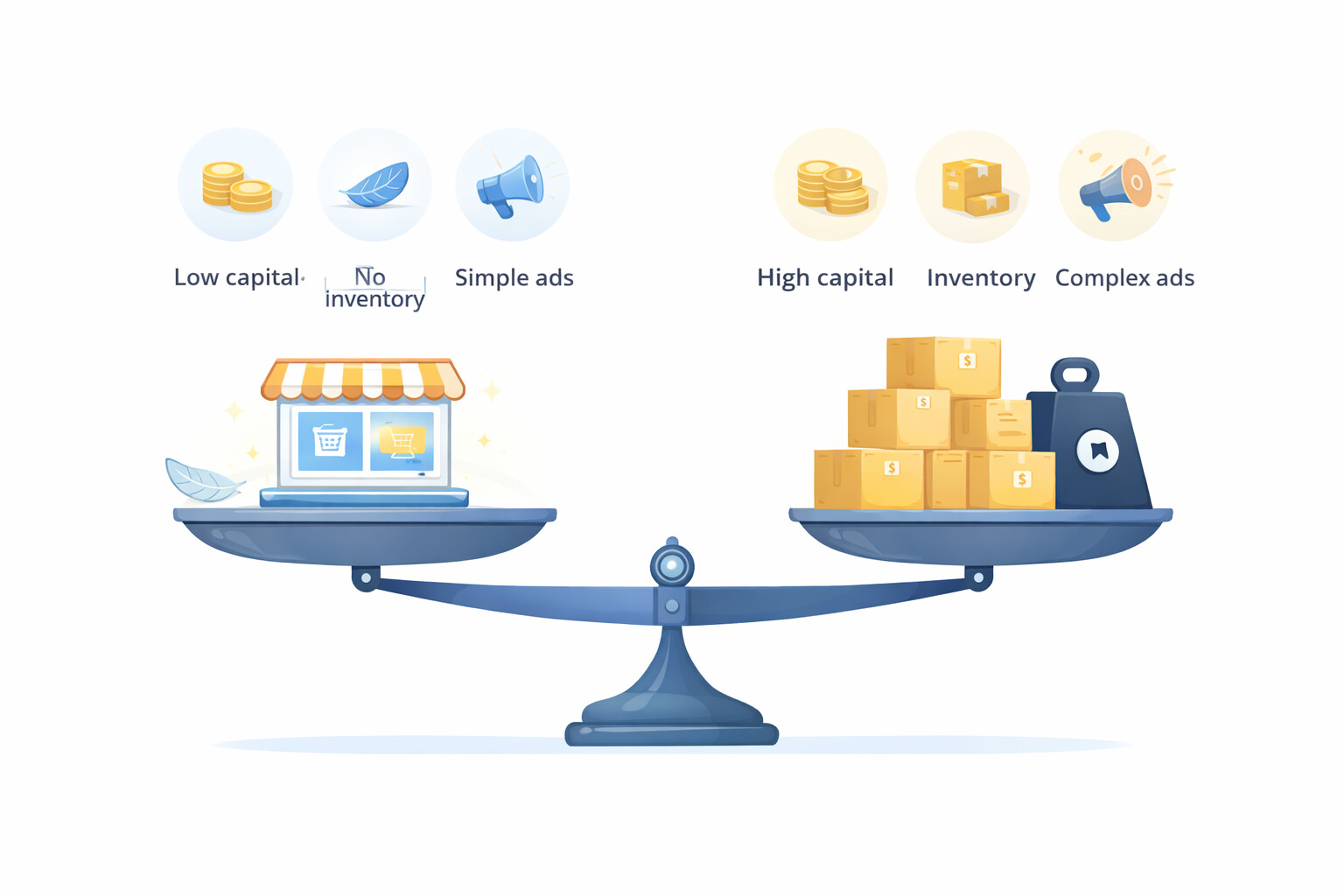
Risk CategorySellviaAmazon FBAUpfront capitalLow ($500-800)High ($3,000-5,000+)Inventory riskZeroSignificantAdvertising complexityLow (automated)High (manual PPC)Platform dependencyModerateHigh (suspensions documented)Learning curve costLow ($200-500)High ($1,000-3,000+)Market sizeSmallerMassiveExit/asset valueLowerHigherScalability ceilingModerateVery high
The honest bottom line
For a beginner with limited capital, limited marketing experience, and limited time to learn multiple complex skills simultaneously - Sellvia carries meaningfully less risk than Amazon FBA at the entry level.
That doesn’t mean FBA is a bad model. It’s a powerful model that has made a lot of people a lot of money. But it’s a model that rewards experience, capital, and operational sophistication. Entering it as a complete beginner with $1,000 and no ecommerce background is genuinely high risk regardless of what YouTube success stories suggest.
Sellvia’s model is narrower and the ceiling is lower. But the floor is also higher. You’re not going to lose $4,000 in stranded inventory. You’re not going to have your account suspended with funds held. You’re not going to burn through your budget learning PPC from scratch against experienced competitors.
The question isn’t which model is better. It’s which model matches your current situation - your capital, your experience, your risk tolerance, and your timeline.
For most beginners reading this post the honest answer is Sellvia first. Learn the fundamentals. Build some revenue. Then decide whether you want to take on the complexity and capital requirements that FBA demands.
Start where the risk matches your resources. Scale into bigger risk as your resources grow. 
Drop your experience below
Has anyone here tried both models - what was your experience switching between them? 
For FBA sellers reading this - what’s the risk you wish someone had warned you about before you started?
And for anyone currently choosing between the two - what’s the specific factor making the decision hardest?
Real experience only. Both platforms have their place and this thread is better with honest voices from both sides.
