Sellvia vs CJ Dropshipping: which one actually works better?
So I did something kind of stupid six months ago. Instead of picking one platform and learning it properly, I decided to run both Sellvia and CJ Dropshipping simultaneously - two stores, two completely different setups, same traffic budget split between them. My original plan was to figure out which one wins in a real head-to-head test, not based on YouTube comparisons or affiliate review articles, but based on actual money spent and actual results.
The short version: they’re not really competing for the same thing. The long version is what this post is about.
Round 1: Setup - CJ wins on paper, Sellvia wins in practice
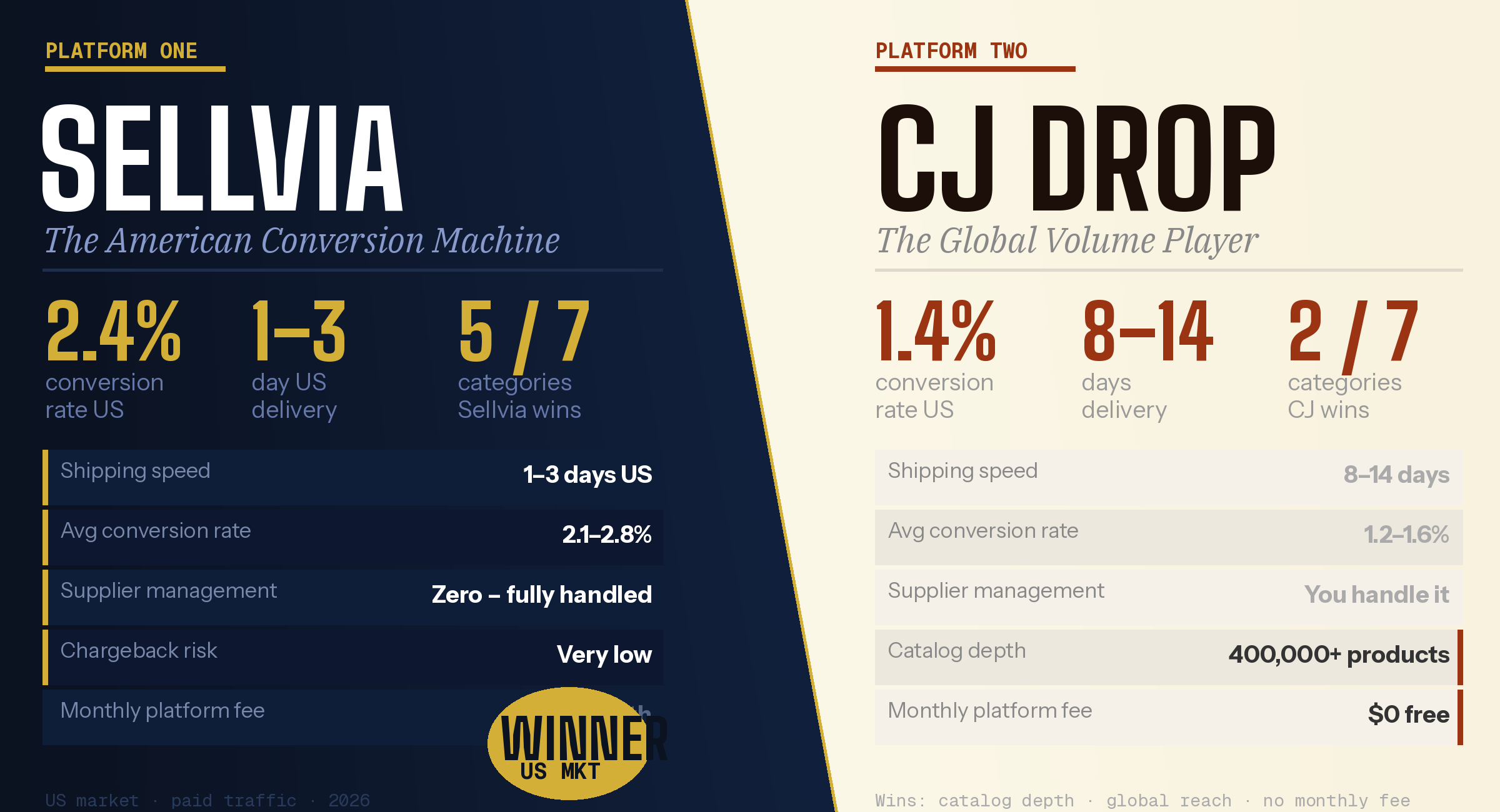
Getting started on CJ Dropshipping is technically faster - you create an account, connect your store, and you’re browsing 400,000+ products within an hour. Free to use. No monthly fee. On paper that sounds like an obvious win over Sellvia’s $39/month subscription.
But here’s what the spec sheet doesn’t tell you: the CJ catalog is enormous and completely overwhelming if you don’t know what you’re looking for. I spent three days just trying to understand which products had reliable fulfillment, which suppliers had decent quality control, which shipping options were actually going to deliver in a reasonable timeframe. It’s like being dropped into a warehouse the size of a city and told to find the six products that will sell.
Sellvia’s setup felt slower at first - the catalog is much smaller, roughly 1,500 products compared to CJ’s 400k. But the curation is real. Products are pre-vetted, descriptions are written, photos are professional. I had a functional store in two and a half days without making a single sourcing decision. For someone who doesn’t know yet what they’re doing, that matters more than it sounds.
Round 2: Shipping - this is where Sellvia breaks away completely
This is the fight that isn’t close. Sellvia fulfills from US warehouses. CJ ships internationally, mostly from China with some US warehouse options for popular products - but availability on those is hit or miss and the product selection in US warehouses is tiny compared to the full catalog.
In practice during my test: Sellvia orders arrived at US customers in 2-4 days consistently. CJ orders with standard shipping took 8-14 days depending on the product. I did find a few CJ products with US warehouse fulfillment that shipped in 4-6 days, but it required significant research per product and the catalog depth in US warehouses is nowhere near what you get with Sellvia.
Why does this matter beyond customer satisfaction? Chargeback rate. Dispute rate. Customer service load. During my six-month test my Sellvia store had one chargeback. My CJ store had eleven - almost all of them shipping-related. “Where is my order” emails consumed hours every week on the CJ side. The Sellvia store basically ran itself operationally once orders were placed.
Round 3: Margins - CJ wins, but the math is more complicated than it looks
CJ’s margins on paper are better. Without a subscription fee and with more competitive wholesale prices on a lot of product categories, you theoretically have more room to run profitable ads. I found products on CJ where the cost was 30-40% lower than comparable Sellvia products.
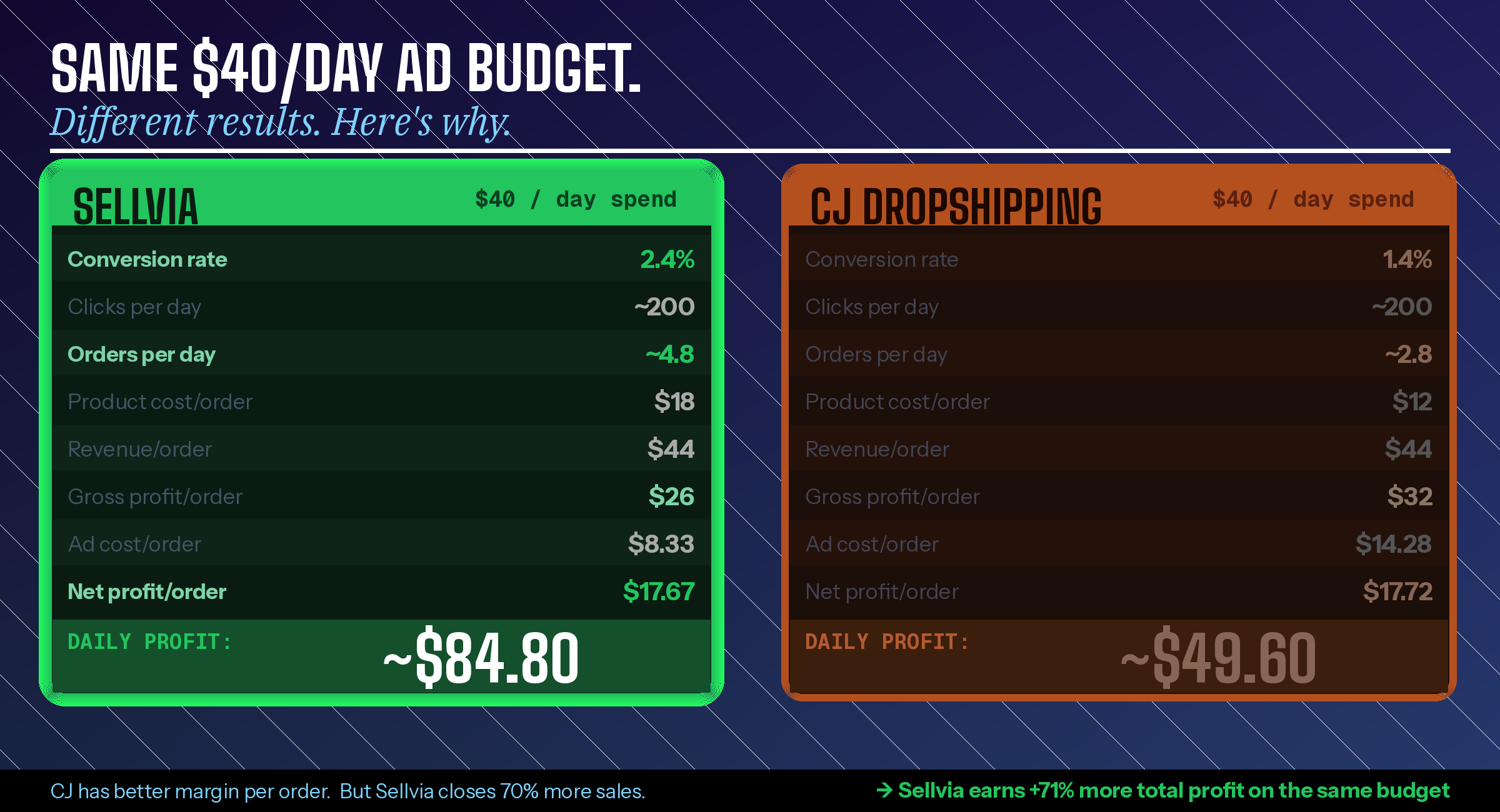
But here’s the thing that changes the calculation: conversion rate. My Sellvia store consistently converted paid traffic at 2.1-2.8%. My CJ store averaged 1.2-1.6% on similar products with similar ad spend. I attributed most of this to the shipping time displayed on product pages - “arrives in 1-3 days” converts cold US traffic differently than “arrives in 8-14 days.” US buyers in 2026 have been trained by Amazon to expect fast delivery and anything longer than a week creates friction that shows up directly in your conversion rate.
When I did the actual math on cost per acquisition, not just product margin, Sellvia came out ahead in every category where the products were comparable. Better conversion rate partially or fully offset the higher product cost in most cases.
Round 4: Product selection - CJ wins, and it’s not close
400,000 products versus 1,500. There’s simply no comparison here in terms of catalog breadth. With CJ you can find products in virtually any niche imaginable, including very specific sub-niches where competition is low and margins are high. Exotic pet accessories. Left-handed tools. Very specific hobby categories. Sellvia just doesn’t have this depth.
This becomes important when you’re trying to find low-competition products in saturated markets. The Sellvia catalog - precisely because it’s curated and popular - tends to have more sellers per product. Everyone on Sellvia sees the same catalog. With CJ’s depth you can genuinely find products that almost nobody else is running ads on.
I found a CJ product in a very specific fitness sub-niche that had literally zero Facebook ads running against it. Ran it for eight weeks before anyone else found it. That kind of opportunity is harder to find on Sellvia because the hunting ground is so much smaller.
Round 5: The complexity tax - Sellvia wins for your sanity
Running a CJ store properly requires managing supplier relationships, monitoring product quality, dealing with stockouts, handling shipping carrier issues, testing multiple fulfillment options per product, and staying on top of which suppliers have gotten sloppy. It’s genuinely a part-time job in itself before you’ve even thought about marketing.
Sellvia eliminates almost all of that. You pay the $39, you pick products, you run ads. The operational layer is handled. For someone who wants to put most of their mental energy into marketing rather than logistics, that’s a real value proposition that doesn’t show up in the monthly fee comparison.
I caught myself spending 4-5 hours per week on CJ operational issues - supplier disputes, quality complaints, shipping errors - that I never experienced with Sellvia. Multiply that across a year and the “free” platform starts looking expensive in a different currency.
The comparison that actually matters: who are you right now?
There’s a thread worth reading that goes deep on how Sellvia stacks up against other platforms in terms of who it’s actually built for: Sellvia vs Shopify dropshipping: what’s the difference? - the discussion in the replies gets into the “infrastructure vs flexibility” tradeoff in a way that applies directly to the Sellvia vs CJ question too.
The honest answer after six months running both is this:
Pick Sellvia if: You’re focused on the US market, you want fast shipping as a competitive advantage built into your model, you’re newer to paid traffic and want to minimize operational variables while you learn, or you’ve tested enough products to know that conversion rate matters more than product cost.
Pick CJ Dropshipping if: You’re targeting multiple countries or non-US markets where Sellvia’s fulfillment doesn’t apply, you need catalog depth to find untapped niches, you’re comfortable managing supplier relationships and operational complexity, or your budget is genuinely too tight for a monthly subscription.
Pick both if: You’re slightly insane like me, or you’re at a stage where you’re scaling and want to use CJ for global markets while running Sellvia for your US audience.
The thing that surprised me most
I went into this test expecting CJ to win on margins and Sellvia to win on shipping, and I’d just pick whichever mattered more for my niche. What I didn’t expect was the conversion rate gap to be as significant as it was. A 0.8-1.2 percentage point difference in conversion rate on $300/day ad spend is the difference between a profitable campaign and a losing one. That gap was consistent across every test I ran, and I’m convinced it’s almost entirely driven by the shipping time difference.
If I had to start over from zero today and pick one platform: Sellvia for the first 6-12 months while learning the fundamentals, then evaluate whether CJ’s catalog depth becomes worth the operational complexity as I scale. The beginner mistake is optimizing for the lowest monthly cost. The actual optimization is for lowest cost per profitable sale, and those are very different numbers.
Questions
Anyone here running both simultaneously like I was - how did you split your product strategy between them? And for people who started on CJ and switched to Sellvia or vice versa - what was the specific breaking point that made you switch? Was it the shipping complaints, the conversion rate, something else entirely?