Sellvia vs Shopify is the comparison that comes up in almost every pre-purchase conversation about either platform. And almost every comparison I’ve read gets it wrong - not by being dishonest, but by framing it as a competition between two products trying to do the same thing. They aren’t. Understanding what each platform is actually designed for makes the choice obvious for most people. Getting confused about what each does is how you end up on the wrong one.
I ran a Shopify store for fourteen months before switching to Sellvia. I’ve been on Sellvia for eleven months. I have real experience with both. This is the comparison I wish had existed before I made either choice. 
What each platform is actually designed to do
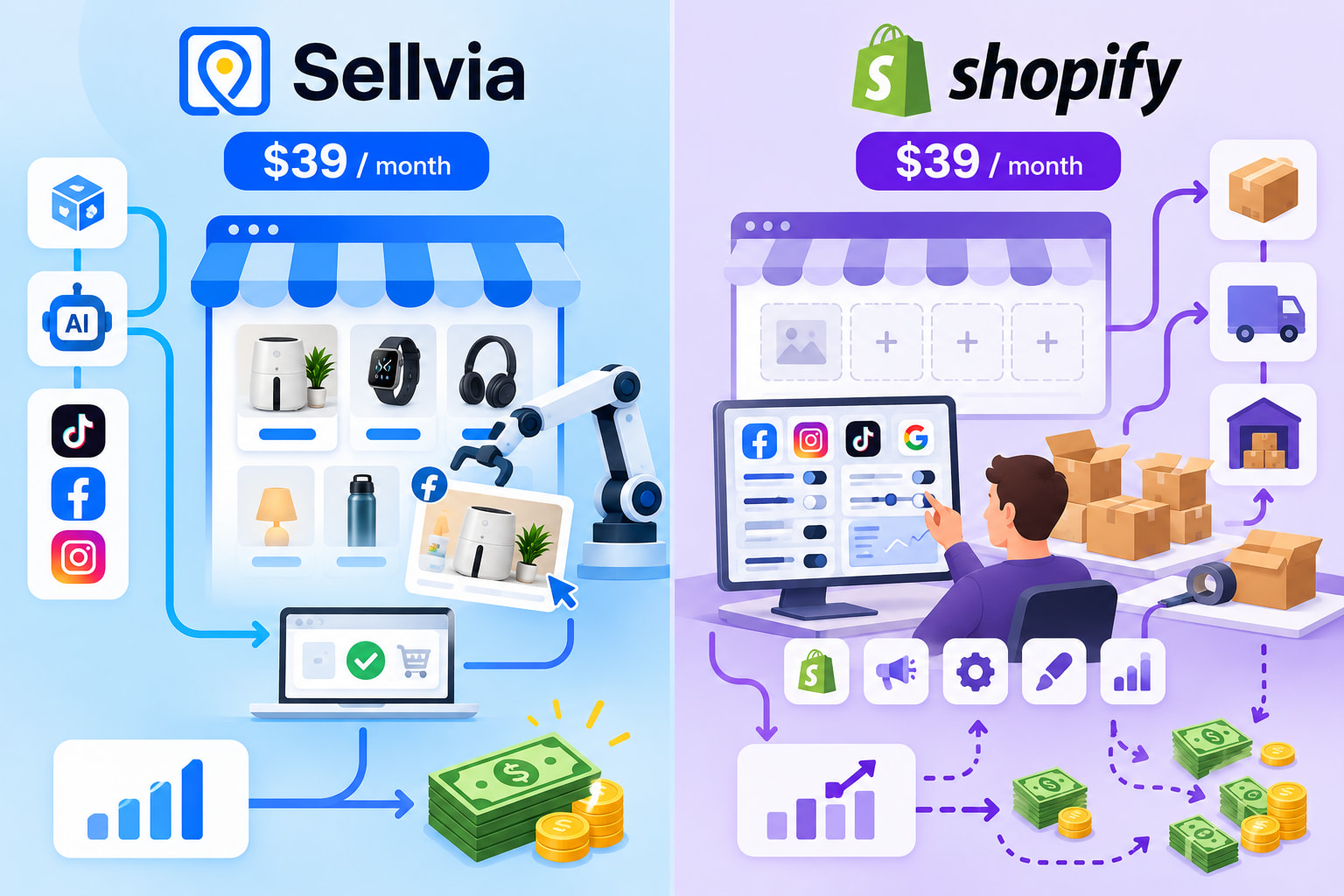
Shopify is an infrastructure platform. It gives you the tools to build, customize, and run an online store. It doesn’t tell you what to sell. It doesn’t run your advertising. It doesn’t source your products. It gives you a highly flexible foundation and expects you to build everything on top of it - product sourcing, marketing, advertising, fulfillment, customer service, analytics. The platform is the container. You fill it.
Sellvia is an operating system for a specific type of business. It gives you a pre-built store with a product catalog of digital goods, a built-in advertising system that handles targeting and placement automatically, a Growth Manager who provides ongoing operational guidance, and Sellvia Market where you can eventually sell the entire business. The platform makes more decisions for you. You operate within its structure rather than building the structure yourself.
Those aren’t competing descriptions of the same thing. They’re descriptions of two fundamentally different products designed for two fundamentally different users. The comparison question isn’t “which is better.” It’s “which matches what I’m actually trying to do.”
The real cost comparison - what you actually spend
Sellvia - monthly costs
Subscription: $39/month
Ads (Silver): $450/month
Processing fees: $80-150/month
Total: ~$570-640/month
Shopify - monthly costs
Basic plan: $39/month
Apps (email, analytics, reviews): $50-120/month
Paid advertising (self-managed): $400-800/month
Product sourcing/licenses: $50-200/month
Total: ~$540-1,160/month
The raw subscription costs are identical - both platforms charge $39/month at their entry level. The total operating cost comparison is more nuanced.
Sellvia’s total cost is more predictable. You know what you’re spending on ads because the package has a fixed daily rate. Processing fees scale with order volume. There are few surprise costs once you understand the structure.
Shopify’s total cost has a much wider range because so many variables are in your hands. A Shopify seller who runs efficient paid advertising and uses minimal apps can operate at similar total costs to Sellvia. A Shopify seller who runs inefficient advertising, needs multiple paid apps, and licenses digital products to sell spends significantly more. The control that makes Shopify powerful is also what makes its cost structure harder to predict, especially for someone without prior ecommerce experience.
The learning curve comparison - what you actually need to know
Sellvia - what you need to learn
Dashboard navigation: 1-2 days
Order processing: 30 minutes
Email setup: 2-3 hours
Pinterest/organic basics: 1-2 weeks
Time to operational: 48-72 hours
Shopify - what you need to learn
Store setup and customization: 1-3 weeks
Product sourcing and licensing: ongoing
Facebook/Google Ads management: 2-6 months
Conversion optimization: ongoing
Time to operational: 3-8 weeks
This is the comparison dimension where the gap between the platforms is largest and where the choice becomes clearest for most people.
On Sellvia you can have a functioning store with active advertising within 48-72 hours of signup. The advertising system handles targeting, placement, and optimization automatically. You don’t need to understand Facebook Business Manager, Google Ads campaign structure, or audience segmentation. You pick a daily budget and let the system run.
On Shopify, running effective paid advertising is a skill that takes months to develop. The platform gives you nothing to run ads with - you build your advertising from scratch on whichever ad platform you choose. For someone who already knows how to run profitable paid ads, this is fine. For someone who doesn’t, it’s a 2-6 month learning curve that costs real money during the learning process.
This is why most experienced Shopify sellers who’ve also used Sellvia describe the two platforms as targeting different users at different experience levels - not as competing for the same customer.
The product comparison - digital vs everything
Sellvia sells digital products exclusively. Courses, guides, templates, systems, tools. No physical inventory, no shipping, no returns management, no supplier relationships to maintain, no stockouts. The buyer pays, the product delivers instantly, you get your commission. Clean, simple, high margin.
Shopify sells whatever you want to sell - physical products, digital products, services, subscriptions, anything. That flexibility is genuinely valuable if you have a specific product in mind that doesn’t fit Sellvia’s digital catalog. It’s irrelevant if digital products are what you want to sell anyway.
The margin comparison at the product level is stark. Sellvia commissions run 50-70% of sale price. Physical product margins on a typical Shopify store in competitive categories run 15-35% after product cost, shipping, and returns. Digital product margins on Sellvia are among the highest available in any ecommerce model at any platform because there are no fulfillment costs to subtract from the sale price.
Sellvia’s core tradeoff is that control is limited in exchange for the operational infrastructure being handled. You can’t run your own advertising campaigns independently of the Sellvia Ads system. Your product selection is constrained to what’s in the catalog. Your store design follows Sellvia’s structure, enhanced by the Premium Business Upgrade if you get it. The platform has made choices that you can’t override.
For most beginners that tradeoff is excellent. The decisions Sellvia has made - about advertising, product quality, store structure - are generally good decisions that would take months to arrive at independently on Shopify. For advanced sellers who have strong views about how they want to run their advertising or who have a specific product vision that the catalog doesn’t support, the constraints become genuinely limiting.
The exit option comparison - what you’re building toward
This is the dimension where Sellvia has a structural advantage that most comparisons overlook entirely.
Sellvia stores can be sold on Sellvia Market after sixty days of operation. The sale multiple - typically 18-25x monthly net profit - is built into a marketplace with an active buyer pool specifically looking for Sellvia stores. A well-built Sellvia store at month nine generating $500/month in net profit can sell for $9,000-12,500. The platform provides the exit infrastructure as part of what you’re building.
Shopify stores can also be sold - through independent brokers, Flippa, Empire Flippers, or direct negotiation. The multiples for small Shopify stores vary widely from 24x to 40x depending on store age, revenue consistency, traffic source quality, and niche. The infrastructure for finding buyers is not built into the platform - you assemble it yourself.
For a first-time online business builder, Sellvia Market provides a more accessible and defined exit path than the independent brokerage process. The tradeoff is that you’re selling within an ecosystem rather than the broader market, which potentially caps the multiple. For a more sophisticated seller with strong financial metrics, the open market available to Shopify stores may produce better total returns.
Who should choose Sellvia
Sellvia is the right choice if:
You’re new to ecommerce and want to test the model without a 3-6 month learning curve for advertising and store setup.
You want digital products specifically and don’t need the flexibility to sell physical goods or custom products.
You have $500-700 to invest and want the highest probability of reaching profitability within 4-6 months with consistent execution.
You’re interested in the build-and-sell model and want a defined exit path through Sellvia Market.
You can commit 45-60 minutes per day but don’t have 3-4 hours per day to manage advertising campaigns and store optimization manually.
Who should choose Shopify
Shopify is the right choice if:
You already know how to run profitable paid advertising or have the time and appetite to develop that skill over 3-6 months.
You have a specific product vision - a physical product line, a proprietary digital product, a brand identity - that requires full control over your store’s design and catalog.
You have an existing audience or traffic source and don’t need a managed advertising system to generate first buyers.
You want maximum flexibility in how you structure your business - pricing, discounting, customer relationships, data ownership.
You’re building toward a larger, more customized operation where Sellvia’s constraints would eventually become limiting.
The honest answer for most people reading this
If you’re in this community reading a Sellvia forum, you’re probably already leaning toward Sellvia. That’s appropriate in most cases. The people for whom Shopify is clearly the better choice are generally people who already have ecommerce experience, know what they want to sell, and have the skills to build the advertising and product operations that Sellvia handles automatically.
The people for whom Sellvia is clearly the better choice are people who want to test whether the digital product ecommerce model works for them without spending six months developing skills before they can find out. Sellvia compresses that learning curve to weeks rather than months. For someone with limited capital and limited time who wants to know whether this type of business is viable for them - that compression is worth a great deal.
Neither platform is better in the abstract. They’re designed for different users at different stages. Know which one you are and the choice is straightforward. 
Drop your experience below
Has anyone here run both platforms seriously? What made you switch and what do you miss from the one you left?
For anyone currently deciding - which specific aspect of this comparison is the one that’s making the choice hard?
 The thing I didn’t anticipate about Shopify was how much of my operational time went into things that weren’t the business itself. Learning Facebook Ads Manager. Debugging pixel tracking. Negotiating with suppliers. Handling shipping complaints. On Sellvia that time goes into the actual business - products, email, organic content, Growth Manager conversations. The operational overhead difference is real and significant. Not that Shopify is bad - it’s excellent for what it does. But “what it does” includes managing a substantial operational overhead that Sellvia simply removes.
 Facebook Ads Manager alone consumed six weeks of meaningful learning time for me before I could run campaigns that didn’t lose money. Six weeks of paying tuition in failed campaigns to develop a skill that Sellvia just removes from the equation. For someone with that skill already, Shopify’s control is pure value. For someone who has to develop it from scratch, it’s an expensive education that Sellvia makes optional.
 My Shopify total cost in month three when I was running Facebook and Google ads at modest budgets and using six paid apps: $847/month. My Sellvia total cost at Silver package: $489/month. The subscription prices are the same. Everything else is where the gap emerges. And that was before factoring in the Shopify transaction fees and the product licensing costs I was paying for digital goods. The $39 subscription comparison that most people lead with is basically meaningless for total cost evaluation.
 Email marketing app: $20-50/month. Review app: $15-30/month. Analytics app: $20-40/month. Upsell app: $15-25/month. Inventory management: $30-60/month. You’re at $100-200/month in apps before you’ve spent a dollar on advertising. None of those are optional if you want to run a serious store. On Sellvia most of that functionality is built in. The $39 vs $39 subscription comparison is genuinely misleading without the app cost comparison attached to it.
 I’m a full-time professional with two kids. Three to eight weeks of intensive platform learning before I can even test whether the business model works for me is a real barrier. Forty-eight hours to first ad running is not. The learning curve difference isn’t just convenience - it’s the difference between being able to test the model within my actual life constraints versus theoretically being able to do it if I had significantly more free time than I have.
 Most people who are evaluating Sellvia aren’t choosing between building a Shopify store with professional expertise or running a Sellvia store. They’re choosing between testing whether ecommerce works for them with the time and skills they currently have or not testing it at all. Sellvia makes the test possible within real constraints. Shopify often makes it only possible in theory.
 I tried to sell a small Shopify store through Flippa. The process took four months, required professional financials, multiple buyer conversations that went nowhere, and ultimately sold at 19x monthly profit after broker fees. My Sellvia Market sale took eleven days from listing to accepted offer at 22x monthly profit with no broker, no independent financials preparation, and a built-in buyer pool. The built-in exit infrastructure has real value that doesn’t show up in the platform feature comparison.