Month one on Sellvia is where most of the expensive lessons happen. Not because the platform is hard to understand - it isn’t. But because the combination of a new system, real money leaving your account daily, and zero results yet creates a specific kind of pressure that makes smart people do counterproductive things.
I’ve been in this community for over a year. I’ve seen the same mistakes appear in forum threads repeatedly - always during month one, always for predictable reasons, always with a quantifiable cost that could have been avoided with better information going in.
This is the list. Eight mistakes, real dollar costs for each, and the specific fix that prevents them. Read it before your first ad dollar is spent. 
Mistake 1 - Not using the $40 coupon on day one
Cost: $40 in expired value
The $40 Sellvia Ads coupon that comes with your trial has an expiration date. Most new sellers spend their first two to four days exploring the dashboard, reading documentation, and getting comfortable before activating ads. By the time they activate, the coupon has often expired or only partially covered their first few days of spend.
The coupon covers four days of Bronze-level advertising or slightly under three days of Silver. That’s real ad spend covered by Sellvia - the algorithm’s first days of data collection funded for you. Letting it expire is leaving $40 on the table for no reason.
Fix: Activate your ads within 24-48 hours of signup, before exploring anything else. The coupon feeds the algorithm during its most data-hungry phase. Use it immediately.
Mistake 2 - Pausing ads during the learning phase
Cost: $150-400 in extended unprofitable operation
Days seven through fourteen of running Sellvia Ads produce the worst-looking results of your entire store lifetime. Traffic is arriving. Ad spend is real. Orders are minimal or zero. Every instinct says something is wrong and the right move is to pause and reassess.
Every instinct is wrong. The algorithm’s learning phase is working during this silence. It’s building the targeting model that will produce your month three CPA of $7-10 from a month one CPA of $25-35. Pausing resets that progress. Partially. Which means when you restart, you partially repeat the learning phase - spending more time in the expensive early optimization period you were trying to escape.
Sellers who pause during days seven through fourteen and restart typically spend an additional two to four weeks in the high-CPA learning phase they just interrupted. At $15/day that’s $210-420 in ad spend to recapture optimization that was already building before the pause.
Fix: Decide your budget before you activate and commit to running it uninterrupted for 21 days minimum. Write it down before you start so you can hold to it when day nine feels like failure.
Mistake 3 - Missing order processing windows
Cost: $30-120 per month in lost commissions
Orders have a processing window. Miss it and the order cancels. The commission you would have earned disappears. The ad spend that generated that visitor and conversion is already gone regardless. You paid to acquire a buyer and then gave the sale back by not showing up to complete it.
At 30 orders per month a 10% missed processing rate is three orders. At an average net commission of $11 per order that’s $33 per month in preventable losses. At 60 orders per month it’s $66 per month. Over a twelve-month operation that compounds into $400-800 in commissions you earned and then gave back for no reason other than not having a system for checking orders consistently.
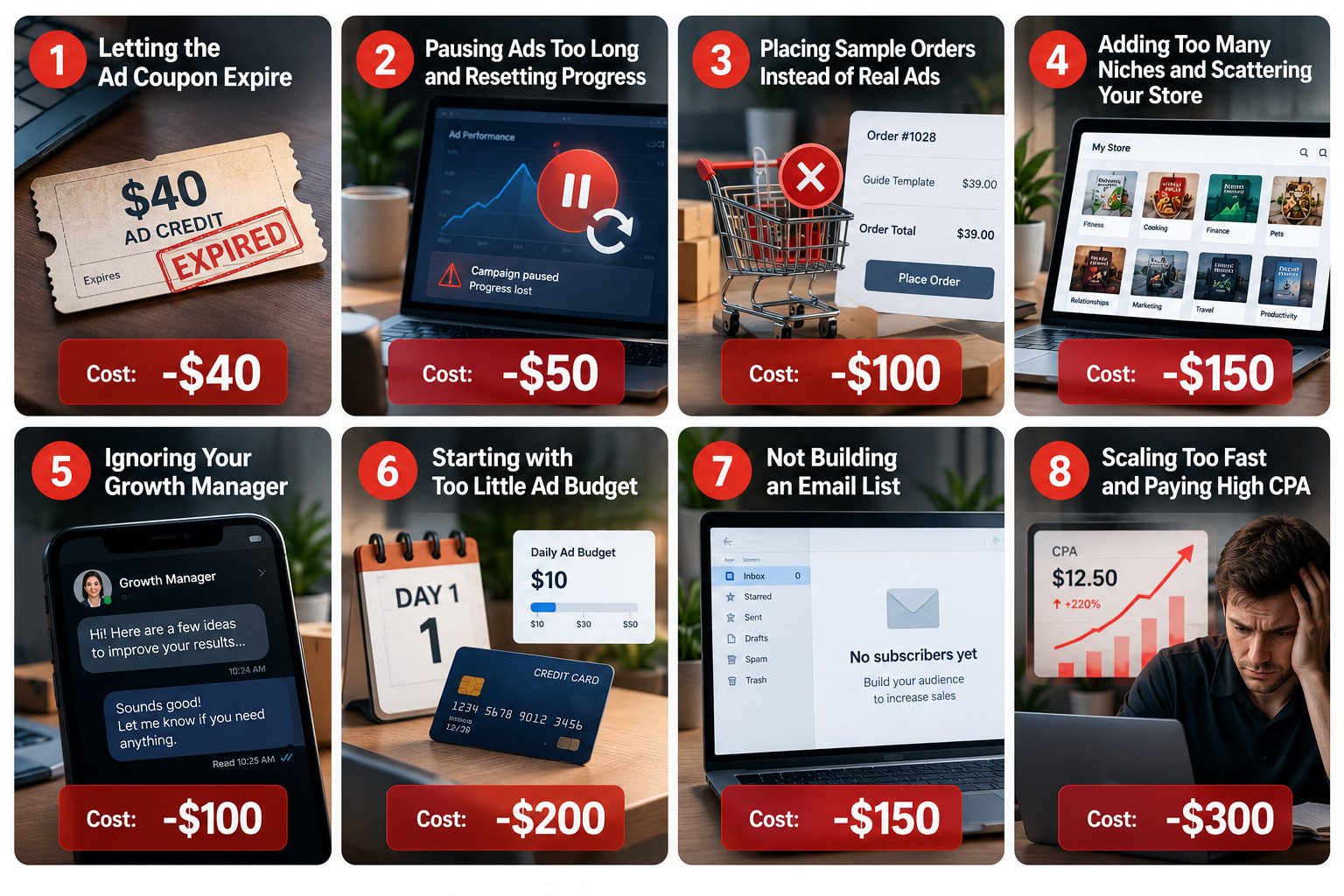
The Sellvia Ads algorithm builds a buyer profile from purchase signals. A scattered catalog sends a confused signal - “our buyers are interested in everything.” The algorithm can’t efficiently find more buyers matching that profile because the profile doesn’t cohere. CPA stays elevated longer. The optimization that should complete in three weeks takes six or seven weeks. The additional time in the high-CPA learning phase costs real money.
The data from this community is consistent: focused stores with ten to twelve products in one niche reach their optimized CPA approximately four to eight weeks faster than scattered stores with thirty products across five categories. At $15/day that’s $420-840 in additional ad spend during the extended optimization period.
Fix: Pick one niche before you sign up. Load ten to twelve products that all serve the same audience with the same type of problem. Don’t add products outside that niche until month three when you have data to make expansion decisions intelligently.
Mistake 5 - Ghosting the Growth Manager
Cost: 1-3 months of suboptimal decisions
The Growth Manager messages you within hours of signup. Most new sellers either don’t respond for days or respond briefly and then let the conversation go cold because it feels like a sales call. This is a mistake with a real opportunity cost.
The Growth Manager has seen hundreds of stores in your exact situation. They know which product categories are currently converting well in which niches. They know the timing mistakes that cost month-one sellers the most money. They know what the data from your specific store configuration looks like and what adjustments typically improve early results. That knowledge is included in your $39/month subscription and most sellers don’t use it.
Sellers who engage their Growth Manager from day one and follow their tactical guidance - not necessarily their upgrade suggestions, but their operational guidance - consistently reach month three profitability faster than sellers who operate in isolation. The difference in timeline translates directly to dollars in or out of your operating budget.
Fix: Respond to your Growth Manager on day one. Tell them your niche, your budget, and your goal. Ask them what the most common month-one mistakes look like for stores with your configuration. Then actually listen to what they say about operations even if you’re skeptical about their upgrade recommendations.
Mistake 6 - Starting underfunded
Cost: Entire investment with no result
This is the mistake with the highest potential total cost because it makes every other mistake worse. Starting with less than $400 available for your first three months creates a scenario where the cash flow gap - the period between ad spend starting and first withdrawable commissions arriving - creates genuine financial pressure that leads to bad decisions.
Sellers who started with $200-300 in available capital consistently report the same pattern: pressure builds around day twenty when ad spend has consumed most of their budget and the withdrawable balance hasn’t yet cleared the $100 minimum. They pause ads. The learning phase resets. They restart with less budget. CPA is back to month-one levels. They conclude the platform doesn’t work and cancel.
The platform didn’t fail them. The budget failed them. The model requires approximately $500-700 to run properly through the three months needed to reach profitability. Below that threshold you’re not testing whether the model works - you’re testing whether the model can work with insufficient runway, which it cannot.
Fix: Before signing up, confirm you have $500-700 available that you can genuinely treat as a business investment without needing it back within 90 days. If you don’t have that yet - save until you do. Starting underfunded is more expensive than delaying a few months to build adequate runway.
Mistake 7 - Not building the email list from day one
Cost: $200-600 in missed commissions by month six
This mistake doesn’t show its cost in month one - which is exactly why it’s so common. Month one sellers are focused on ads, CPA, and first orders. The email list feels like something to worry about “once things are working.” By the time things are working the list that could have been building for four months is three to four months behind where it would have been.
At month five, a seller who started their email list on day one typically has 150-200 subscribers. A seller who started at month three has 60-80. The month five email contribution from 180 subscribers versus 70 subscribers is approximately eight to twelve additional orders per month at near-zero acquisition cost. At $11 average net commission per order that’s $88-132 per month in email-driven commission the delayed list builder doesn’t have.
Over the remaining months of the store’s operation before a Sellvia Market sale, that compounding shortfall is significant. The email list you didn’t start in month one is the most expensive invisible mistake on this list.
Fix: Set up email capture before you activate your first ad. A simple popup offering a free relevant resource from your niche is sufficient. The tool setup takes two hours. Every day you delay is a subscriber you’ll never get back.
Mistake 8 - Drawing conclusions from day 3 data
Cost: Entire investment abandoned at worst possible moment
The most expensive single mistake in the entire list. A seller activates ads on day one. Day two: sixty visitors, zero orders. Day three: forty-four visitors, zero orders. Day four: they post in this forum asking if the platform is a scam, or they cancel, or they change their entire product selection based on three days of learning phase data.
Three days of Sellvia Ads data is not signal. It’s noise. The algorithm has barely begun building the targeting model that will eventually produce your optimized CPA. The visitors arriving on days two and three are broad, low-quality traffic from early targeting that the system hasn’t had time to refine. Zero orders on day three is expected, normal, and completely uninformative about what your store will produce on day twenty-one.
Sellers who cancel on day four almost always do so right before the first order would have arrived. Sellers who cancel on day ten do so right before the algorithm would have begun showing visible optimization. The pattern is consistent enough to be predictable: the worst emotional moment to evaluate the platform is almost exactly when most people choose to evaluate it.
Fix: Commit to a 21-day minimum evaluation period before drawing any conclusions. Not 24 hours. Not 10 days. 21 days. Write it down before you start. The commitment protects you from your own worst instincts at the worst possible moment.
The combined cost of making all eight mistakes
If you added up the cost of making all eight mistakes in a single month-one experience: approximately $800-1,500 in lost commissions, wasted ad spend, and extended operation in unprofitable territory. Against a total first-month operating cost of $489-639 for a Silver-package store. The mistakes cost more than the platform.
None of them require special skills to avoid. They require specific knowledge that most sellers don’t have before they start because no single source has put it all in one place with the real dollar costs attached.
Now you have it. Read this before day one. Not after day three when you’re already making mistake number eight. 
Drop your experience below
Which of these eight mistakes did you make in month one - and what did it actually cost you?
For anyone about to start: which mistake feels most likely to be the one you’ll struggle with based on how you know yourself?
 Paused ads on day nine of my first attempt. Restarted four days later. Watched my CPA go from the $22 it had dropped to back up to $31 at restart. Spent three additional weeks getting back to the same optimization level I’d been at before the pause. At $15/day that’s approximately $315 in additional ad spend to recapture progress I’d already built. The four-day pause to “reassess” cost three additional weeks of elevated CPA. The math on pausing almost never works in your favor during the learning phase.
 When you’re in day nine with zero orders the pause feels like the responsible move - stop spending money on something that isn’t working. But the spending isn’t what’s not working. The optimization is working, just invisibly. The pause stops the thing that was actually progressing. Knowing the dollar cost of that intervention in advance is what makes it possible to not make it.
 Started my email list at month three. Have 220 subscribers now at month nine. If I’d started at month one I’d have 340-380 subscribers at the same stage based on the growth rate I’ve observed. Those additional 120-160 subscribers represent approximately eight to twelve additional email-driven orders per month. At $11 average commission that’s $88-132 per month I don’t have because I delayed a setup that would have taken two hours in month one.
 The “costs the most in aggregate” framing for the email delay is exactly right. Each individual month the cost is $88-132 - annoying but not dramatic. Over six months it’s $528-792. Over twelve months of operation before a Sellvia Market sale it’s over a thousand dollars in missed commission from a two-hour setup you kept postponing. The invisible compounding cost is what makes this the most underestimated mistake on the list.
 Took six months to reach the CPA I hit in month three on my second store with 11 focused products. The scattered catalog extended my learning phase by approximately eight weeks at $15/day - that’s $840 in additional ad spend before reaching the same optimization level my focused second store hit much faster. The cost of a scattered launch isn’t just slow results. It’s real money spent on an extended learning phase that focus would have shortened dramatically.
 Eight weeks at $15/day is $840. The argument for adding products from multiple categories - “more options means more conversions” - fails completely against the algorithm mechanics. The algorithm doesn’t benefit from more options. It benefits from a clearer signal about which type of buyer to find. Fewer focused products give it a clearer signal. The algorithm does more with less when the less is coherent.
 Starting with $200-300 doesn’t just risk the investment. It almost guarantees a negative experience because the financial pressure that builds by day twenty is severe enough to override every good intention about patience and consistency. You can intellectually know that pausing is counterproductive. You can know that 21 days is the minimum. But when you’re watching your bank account approach zero and your Sellvia balance has $67 that you can’t withdraw yet - the psychological pressure produces decisions that intellectual knowledge can’t prevent. The underfunding isn’t just a financial mistake. It’s a decision-making environment mistake that makes every other mistake more likely.
 It’s not just that you run out of money. It’s that financial stress actively impairs the quality of every decision you make about the store. The patience that month-one success requires is almost impossible to maintain when the financial pressure is real. Adequate runway isn’t just a budgeting requirement. It’s a psychological requirement for making the decisions that produce the outcomes you’re aiming for.
 Came back to the conversation at month two after reading that I was probably leaving useful guidance on the table. The first substantive conversation produced three specific product recommendations that improved my conversion rate in the following three weeks. I estimated later that engaging five weeks earlier would have moved my break-even point approximately three weeks earlier. At $450/month in operating costs, three weeks earlier break-even is roughly $350 in net improvement. For the cost of responding to a message I’d already received.
 Mistake number eight, caught in real time. The 21-day commitment the post recommends is now written on a physical sticky note on my monitor. Not a digital reminder. A physical piece of paper I have to look at to get to my keyboard. Reading the specific description of what day four silence actually means - learning phase data collection, not failure - changed my interpretation of the exact experience I’m having right now. Staying in it.