Is Dropshipping in 2026 Still Worth Starting - Or Are We Just Late to the Party?
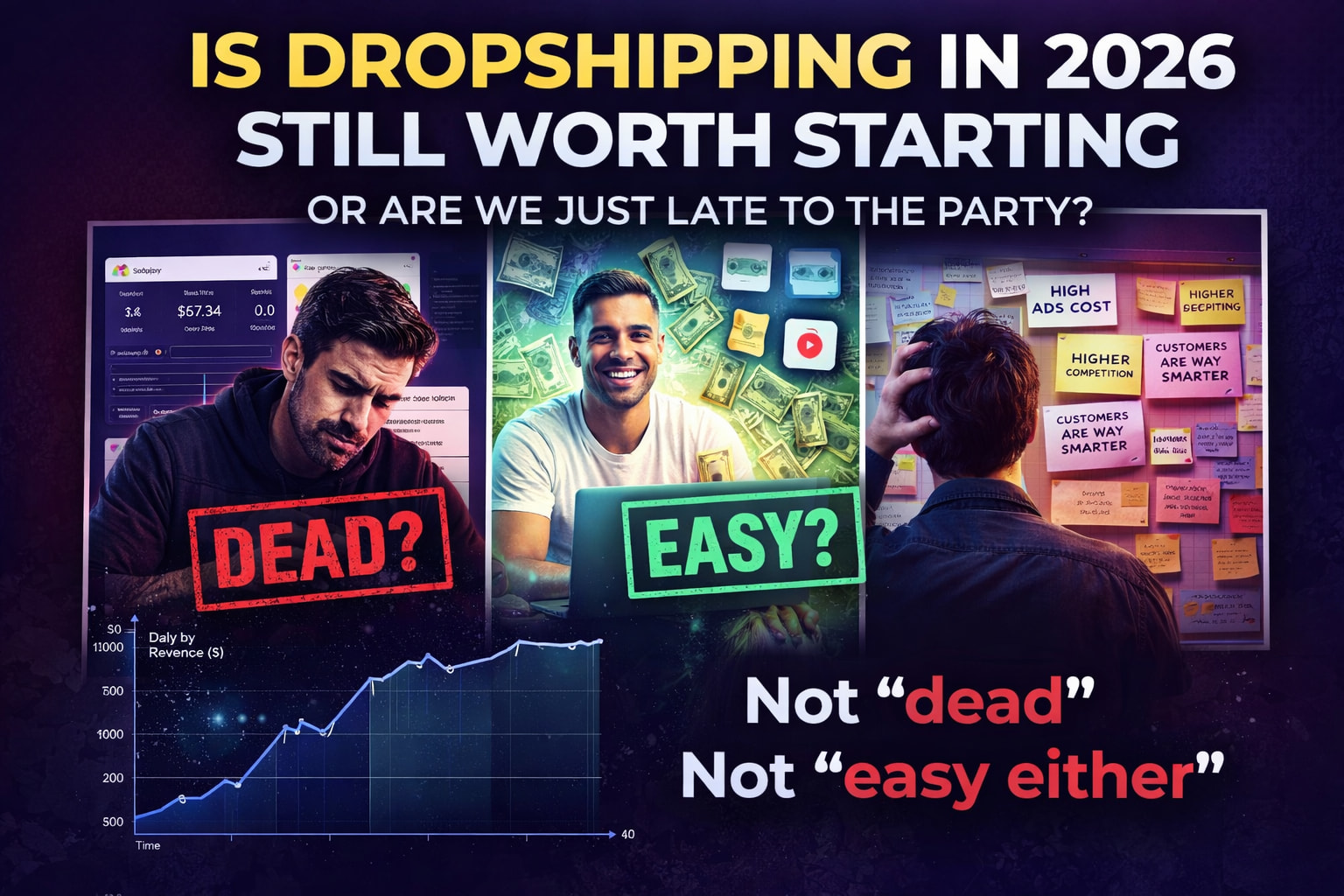
Alright, I’m just gonna say it.
Every time someone new shows up and asks, “Is dropshipping still worth it in 2026?” the comments explode like it’s a war zone.
Half the people are like,
“Bro it’s dead.”
“You missed the wave.”
“Should’ve started in 2017.”
“Margins are trash now.”
And the other half?
“Easiest money ever.”
“AI does everything.”
“Just find a winning product and scale.”
So what is it? Is this thing dead or is everyone just dramatic?
Because if it was actually dead, people wouldn’t still be arguing about it every single week.
Here’s the uncomfortable truth: it’s not dead.
But it’s not easy either. And that’s where most people get confused.
Back in the day, you could throw up a store that looked like it was built during a power outage, run some random ads, and somehow squeeze out profit. That era? Yeah, that one’s gone. The “I saw this on YouTube yesterday and I’m rich by Friday” phase is over.
But that doesn’t mean the whole model collapsed. It just means the easy money crowd got filtered out.
And honestly? That’s probably a good thing.
Because what people really miss isn’t dropshipping. They miss low competition and cheap ads. They miss when customers weren’t skeptical. They miss when nobody knew what a Shopify store looked like.
Now customers are smarter. They’ve seen it all. They know when a product page feels copy-pasted. They can smell a generic store from three scrolls away.
That doesn’t kill the model. It just raises the bar.
And here’s the part nobody likes hearing: most people don’t actually want to raise their bar.
They want confirmation. They want someone to say, “Yeah bro, it’s still easy.” Or they want someone to validate quitting by saying, “Yeah bro, it’s saturated.”
What they don’t want is, “It works, but you’re going to have to actually build something.”
Because that’s less sexy.
Starting today is easier than ever from a tools perspective. You can build a store in a day. You can generate product descriptions in seconds. You can spy competitors without even trying. You can launch ads without hiring anyone.
So yeah, entry is easy.
But winning? Winning is harder.
And that’s where the confusion starts.
People mistake “easy to start” for “easy to succeed.”
Two completely different things.
The real shift in 2026 isn’t that dropshipping stopped working. It’s that it stopped being beginner-friendly at scale.
You can still make a few sales. You can still test. You can still catch momentum. But if you want consistency? If you want real monthly stability? Now you’re playing a different game.
You need better positioning. Better creatives. Better understanding of margins. You need to think about AOV. You need to think about retention. You need to understand cash flow timing instead of celebrating raw revenue.
And most people don’t even want to think about that stuff. They just want to see green days.
The funny thing is, people love saying “It’s saturated.” But what does that even mean?
Online shopping isn’t shrinking. People aren’t suddenly going back to malls. Ecommerce keeps growing. Attention keeps shifting online.
So the opportunity didn’t disappear.
The easy version did.
There’s a big difference.
If you’re trying to run the exact same playbook that worked when competition was lower, yeah, it’s going to feel impossible. But that doesn’t mean the market’s dead. It just means you’re using outdated tactics.
It’s kind of like walking into the gym and saying, “This place is saturated.” No. It’s just that now you actually have to lift heavier.
Another thing people don’t talk about enough is emotional expectations.
A lot of beginners expect clarity in two weeks. Like, “If this works, I’ll know fast.”
That mindset alone kills more stores than ad costs ever will.
Two weeks isn’t enough time to properly test creatives. It’s barely enough to understand your numbers. One bad audience or one weak ad angle can completely distort your results.
But instead of adjusting, people panic. And when they panic, they look for a villain. Platform. Supplier. Ads. Market. “It’s saturated.”
It’s easier to blame saturation than to admit your positioning was weak.
Now don’t get me wrong. This isn’t some “just work harder bro” speech. Margins are tighter. Ads are more competitive. Customers expect faster shipping and cleaner branding. That’s real.
But the people who are still scaling? They’re not superhuman. They’re just treating it like a business instead of a shortcut.
They’re patient enough to test properly. They’re disciplined enough not to jump to a new product every time numbers dip for three days. They understand that volatility is part of ecommerce.
Because here’s something that shocks beginners: even profitable stores have bad days. Even solid offers have slow weeks. That doesn’t mean the whole thing collapsed.
So are we late?
We’re late to the “easy mode” version, yes.
But we’re not late to ecommerce. Not even close.
If anything, the market is maturing. And mature markets reward operators, not dabblers.
And maybe that’s the real dividing line in 2026.
Not “Is dropshipping dead?”
But “Are you willing to operate at a higher level than the average person?”
Because the average person quits fast. The average person restarts every three months. The average person blames the system.
The ones who stick around long enough to actually understand the mechanics? They’re still here. Quietly building. Not screaming “dead” every time they hit a rough week.
This section isn’t about hyping the model or trashing it. It’s about having real conversations about where the game actually stands.
And right now?
It’s not dead.
It’s just not forgiving anymore.
So What Actually Makes Someone “Too Late”?
Let’s flip the question around.
Maybe it’s not about the year.
Maybe it’s about the mindset you enter with.
Because I’ve seen people start in “good years” and still fail.
And I’ve seen people start in “bad years” and quietly build something solid.
Being “too late” isn’t about timing. It’s about expectations.
If you come in thinking this is still a glitch in the matrix where money falls out of ads, yeah… you’re late.
If you come in understanding this is basically performance marketing plus supply chain plus customer psychology? You’re not late at all. You’re just early in your learning curve.
And that’s the part nobody wants to sit through - the learning curve.
The Plateau Nobody Warns You About
Here’s something that doesn’t get talked about enough.
Most stores don’t instantly fail.
They plateau.
You get a few sales. Maybe you even hit a decent month. You start thinking, “Okay… this might actually work.”
And then it just… stalls.
Not dead. Not booming. Just stuck.
That’s where most people quietly disappear.
Because early momentum feels exciting. But improving something that’s “kind of working” is harder than starting from scratch. So what do people do?
They scrap it.
New niche. New store. New “strategy.” New fresh start.
And they repeat that cycle for a year.
The problem isn’t that dropshipping stopped working. The problem is people never stay long enough to refine anything.
Scaling isn’t about finding something magical. It’s about taking something decent and slowly making it better.
Better landing page.
Better offer.
Better angle.
Better creative.
Better retention.
Boring? Yeah.
Effective? Also yeah.
The Hidden Cost of Chasing Trends
Trend chasing feels productive. It feels like you’re “on it.”
New product drops. You rush. Build store in 24 hours. Launch ads. Get excited.
Maybe you even catch a little spike.
Then it fades.
Now you’re back at zero, except more tired.
Trend chasing is addictive because it gives you short bursts of hope. But long-term? It keeps you unstable.
The stores that survive longer than a few months usually aren’t built on hype. They’re built on solving something consistently.
Not viral. Not flashy. Just consistent demand.
But consistency is less sexy than “next big thing.”
So most people don’t choose it.
Let’s Talk About Money (For Real)
Another reason people feel “late” is margins.
Ads cost more. Competition pushes prices. Shipping isn’t free. Payment processors hold funds.
You look at the numbers and think, “How is anyone making real profit?”
Here’s what changed: lazy margin stacking doesn’t work anymore.
You can’t just buy for $10 and sell for $39 and call it a day.
Now you need:
- Higher AOV.
- Upsells.
- Bundles.
- Email flows.
- Repeat purchases.
The people who treat every order as a one-time event struggle.
The people who think, “How do I make this customer worth more over time?” survive.
That shift alone separates dabblers from operators.
The Emotional Side Nobody Admits
Let’s be real for a second.
This business messes with your head.
You can have three solid days in a row and feel like a genius.
Then two quiet days hit and suddenly you’re questioning everything.
“Is the product dying?”
“Did the algorithm change?”
“Am I shadow banned?”
“Is it saturated?”
No. It’s ecommerce.
Volatility is normal.
But beginners interpret normal fluctuation as collapse.
Experienced operators zoom out. They look at weekly numbers. Monthly numbers. Trends over time.
If you react emotionally to every daily dip, this game will drain you.
That’s not a platform problem. That’s a psychological one.
Building a Brand… Or Just Flipping?
Here’s another uncomfortable topic.
Are you trying to build something… or just flip products until something sticks?
Both approaches exist.
Flipping can make money. Fast sometimes. But it’s chaotic. You’re always hunting.
Building something slower feels boring at first. But over time, it compounds.
Recognition compounds.
Trust compounds.
Conversion rate improves.
Return customers increase.
But building means sticking with something long enough to actually shape it.
And that’s where most people tap out.
Because sticking with something through slow weeks requires belief without instant validation.
That’s rare.
So Is It Worth Starting Now?
If you’re looking for easy mode, no.
If you’re okay with:
-
Learning.
-
Testing.
-
Failing small.
-
Improving.
-
Thinking long-term.
Then yes.
The opportunity didn’t vanish. It evolved.
And evolution filters people.
In 2026, the barrier isn’t technical. It’s mental.
You can build a store in hours. You can launch ads in minutes. Tools are insane now.
But discipline? Patience? Emotional control?
Those are still manual.
And that’s why the “too late” narrative spreads so fast.
Because it’s easier to say, “I missed it,” than to say, “I wasn’t ready to level up.”
Final Thought (And No, This Isn’t Motivational Garbage)
Dropshipping isn’t a hack anymore.
It’s just a business model.
That’s it.
And business models reward people who treat them seriously.
If you approach it like a casino, it’ll treat you like a gambler.
If you approach it like an operator, you at least give yourself a real shot.
So no, you’re not automatically late because it’s 2026.
You’re only late if you’re still expecting 2018 rules.
The game changed 
It didn’t disappear.
 tho fr
 the loudest “it’s dead” people are usually the ones who never launched anything. there’s a whole graveyard of people who spent 2 months “doing research” and called it saturated without ever running a single ad