Sellvia vs Shopify dropshipping: what’s the difference?
Okay so this is one of those questions that keeps coming up in every ecom community I’ve been part of, and the answers are almost always terrible. Either you get someone who’s only ever used one platform telling you theirs is obviously better, or you get a listicle that was clearly written by someone who’s never actually run a store. I’ve spent real time with both setups - not just dabbling for a week, but actually running stores, spending real ad budget, dealing with suppliers, handling customer complaints - so let me give you an honest breakdown of what’s actually different between these two approaches.
Quick disclaimer before we get into it: this isn’t a “one is objectively better” post. Anyone who tells you one approach is universally superior hasn’t thought about it hard enough. They solve different problems for different types of people at different stages. The goal here is to help you figure out which one fits where you actually are right now.
Starting from the basics - what are we actually comparing?
First thing to understand is that Shopify dropshipping and Sellvia aren’t really the same category of thing, even though people treat them like direct competitors. Shopify is a platform that lets you build an online store. Dropshipping with Shopify typically means sourcing products from suppliers - historically AliExpress, but increasingly from domestic suppliers through apps like AutoDS, Zendrop, or direct relationships - and selling them without holding inventory.
Sellvia is a more integrated system. It’s a platform that includes the store builder, a product catalog, AND US-based fulfillment all in one package. You’re not stitching together a store builder with a supplier app with a fulfillment partner. It’s one thing that does all of that together.
That distinction matters a lot when you’re thinking about setup, complexity, and who each approach actually works for.
Setup experience: weeks vs days
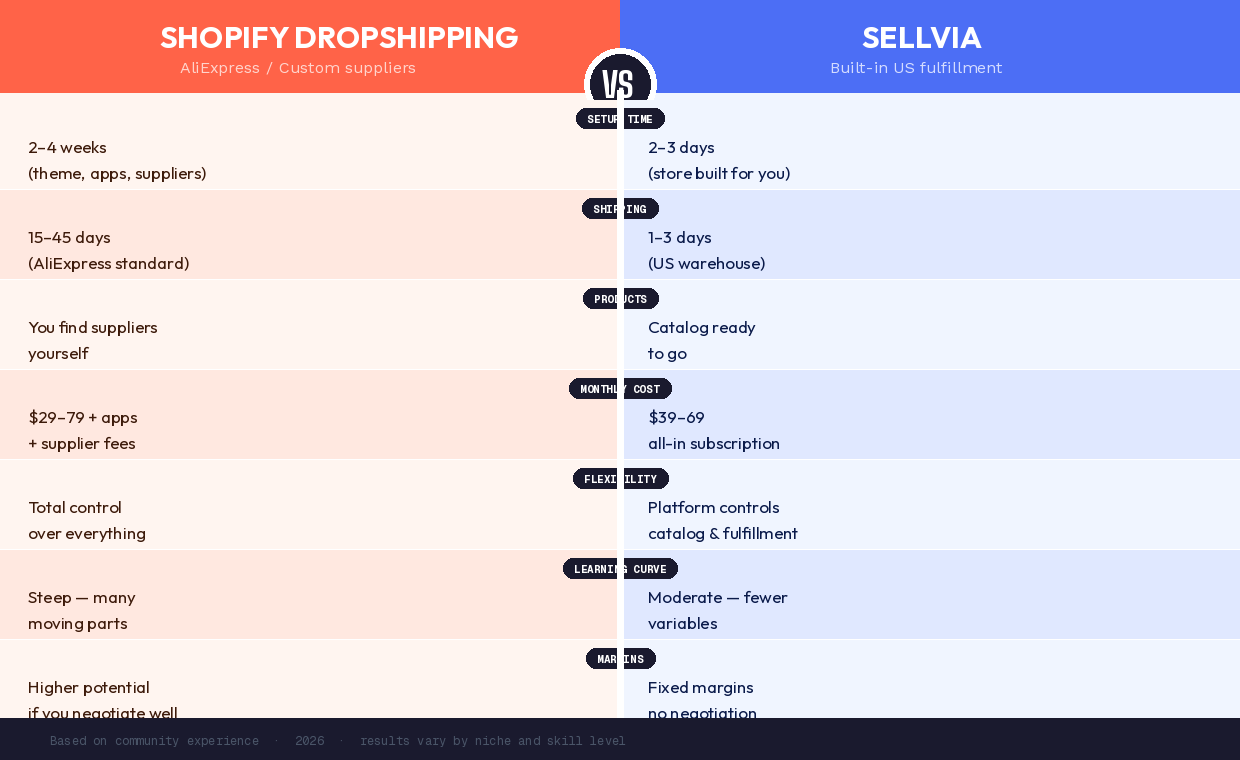
If you’ve ever built a Shopify store from scratch, you know the process. You pick a plan, choose a theme, customize it, figure out which apps you need, install them, connect a payment processor, find your suppliers, negotiate terms or at least compare pricing, import products, write or edit descriptions, set up shipping rules, configure taxes… it goes on. For a first-timer doing this without a clear roadmap, it can genuinely take four to six weeks before you have something ready to test seriously. Some people love that building process. A lot of people burn out somewhere in the middle of it and never get to the part where they actually sell anything.
Sellvia’s setup is a completely different experience. You pick a niche, they build the store for you on their own platform, products are already loaded with descriptions and images, fulfillment is pre-connected. Most people are operational within two to three days. That’s not a marketing claim - it’s just how the system is designed. The tradeoff is you’re working within their framework rather than having a blank canvas.
For someone who wants to validate whether ecom is even for them without committing months of work to setup, Sellvia’s approach has real appeal. For someone who wants full control from day one and doesn’t mind the setup time, Shopify’s blank canvas is worth the effort.
Shipping speed - where Sellvia has a clear and undeniable advantage
This is the area where the comparison becomes most one-sided. AliExpress standard shipping in 2026 is realistically 15 to 45 days depending on the product, the supplier, and what’s happening with logistics at any given moment. And that kind of shipping timeline is genuinely a customer experience problem in a world where people are used to Amazon two-day delivery. It’s not that customers won’t occasionally accept longer shipping if the price is right - some will. But the volume of “where is my order” emails, the chargeback rates, the negative reviews, the refund requests - all of that scales with shipping time. Running an AliExpress dropshipping store means building customer service infrastructure around managing shipping frustration as a core part of your operation.
Sellvia’s US warehouse fulfillment changes that equation entirely. One to three day delivery means customers get what they ordered before they’ve had time to get anxious about it. Chargeback rates drop noticeably. Refund requests go down. Customer satisfaction reviews improve. If you’ve made the switch from overseas to domestic fulfillment you know exactly how big a difference this is in practice - it’s not marginal, it’s substantial.
This is Sellvia’s strongest argument and it’s a legitimate one. Fast domestic fulfillment is genuinely valuable and the Sellvia platform delivers it reliably.
The margin equation - more nuanced than people admit
Here’s where the comparison gets more complicated and where I’d push back on people who say Sellvia is just obviously better. Margin potential on Shopify dropshipping - done properly - is meaningfully higher than Sellvia’s fixed catalog margins.
When you build direct supplier relationships, negotiate pricing based on volume, find products that aren’t yet saturated in the market, and build a brand around them, your margins can get significantly better than what Sellvia offers. The ceiling is higher. Experienced Shopify dropshippers who’ve built solid supplier networks are operating at economics that Sellvia’s catalog pricing simply can’t match.
But - and this is important - that margin ceiling comes with real costs. You’re managing supplier relationships that can go sideways. Quality control is your problem. If a supplier drops a product or goes dark, you’re scrambling. The complexity of managing multiple supplier integrations, dealing with inconsistent inventory data, handling the variability in product quality - it’s significant operational overhead.
Sellvia’s fixed margins are lower but they come with something valuable: predictability. You know your cost structure, you know what you’re working with, and you’re not spending time managing supplier drama. For a beginner or someone treating ecom as a side business rather than a full-time operation, that predictability is often worth more than the theoretical ceiling on margins.
The smart approach is understanding that you’re making a tradeoff, not choosing between a good option and a bad one.
Cost structure: more similar than the headlines suggest
People often compare Sellvia’s subscription fee to Shopify’s base plan and conclude they’re roughly equivalent or that one is clearly cheaper. But the full cost comparison is more complicated than that.
Shopify at $29-79 per month for the platform doesn’t include the apps you’ll actually need - product importing tools, email marketing, review apps, upsell tools, analytics - and those add up fast. Then you have supplier costs, which vary depending on your sourcing approach. Building out a proper Shopify dropshipping operation with a competitive app stack typically runs $100-200 per month in platform and tool costs before you factor in any ad spend.
Sellvia’s subscription is more all-in, but there are still costs beyond it - the one-time store setup fee if you go that route, add-ons within the platform, and the same ad spend requirements that apply regardless of which platform you’re using.
Neither is dramatically cheaper than the other when you look at the full picture. The Shopify setup potentially gives you more flexibility for where that money goes. The Sellvia setup is more predictable in what you’re paying for.
Flexibility vs simplicity - know which you actually need
This is the core tension between the two approaches and it comes down to an honest assessment of what you actually need right now versus what sounds good in theory.
Shopify gives you flexibility. You can build any store, sell any product, use any supplier, integrate with any tool, and take the business in any direction. If you want to build a private label brand, you can. If you want to expand into multiple niches, you can. If you want to integrate with wholesale suppliers, you can. The platform gets out of your way and lets you build whatever you want.
Sellvia gives you simplicity. The decisions are made for you in a lot of areas. The product catalog is defined. The fulfillment system works one way. The store structure is set up for you. If you want to do something outside that framework you’re either working around limitations or you’re looking at the wrong platform.
For a beginner, simplicity is often genuinely more valuable than flexibility, even though flexibility sounds more appealing. Having fewer decisions to make early on means you can focus on learning the things that actually matter - how to drive traffic, how to write copy that converts, how to run ads profitably. Those skills transfer to any platform. Learning Shopify’s app ecosystem doesn’t transfer anywhere.
Who actually wins on which dimensions
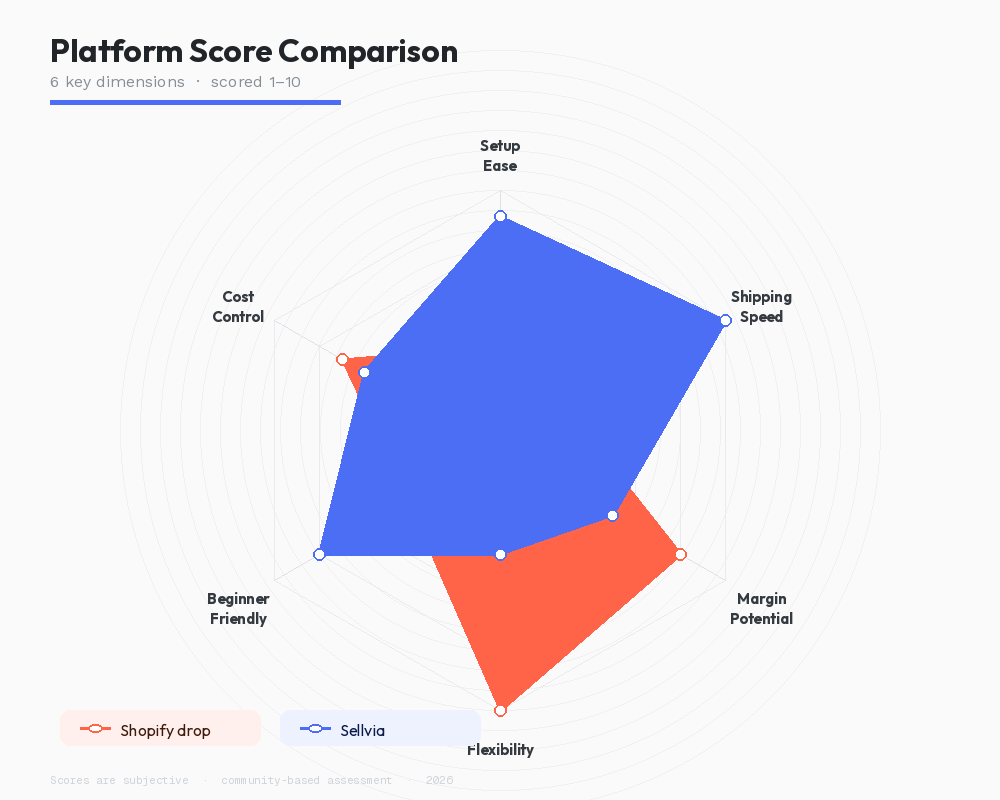
Setting it out plainly: Sellvia wins on setup speed, shipping experience, and beginner accessibility. Shopify dropshipping wins on flexibility, margin ceiling, and long-term scalability. They’re roughly equivalent on monthly cost when you account for everything. The learning curve is steeper on Shopify but the knowledge you build is more transferable.
A thread I came across recently did a really thorough job of looking at where the actual financial risk sits with each approach in 2026 - not just the surface-level costs but where people actually lose money: Sellvia vs AliExpress in 2026 - where is the real risk. The risk analysis is genuinely useful context if you’re trying to make this decision with your eyes open.
My actual recommendation based on where you’re starting from
If you’re new to ecom, haven’t made your first sale yet, and you’re trying to figure out if this is worth pursuing - start with Sellvia. The lower setup complexity means you’ll get to the part that actually teaches you things (running traffic, making sales, handling customers) faster. You can always migrate to a more complex setup once you know what you’re doing.
If you have some ecom experience already, understand how traffic works, and you’re ready to invest in building something with real margin potential - the Shopify route with proper supplier sourcing is worth the complexity. The higher ceiling is accessible once you have the skills to reach it.
If you’re running a business already and ecom is a side project - Sellvia’s lower time investment makes more sense. You don’t have the bandwidth for the Shopify learning curve and that’s fine.
The two platforms aren’t really in competition for the same person. They’re serving different stages of the same journey. Pick the right tool for where you are right now, not where you want to be eventually.
Questions
Has anyone here made the switch from Shopify dropshipping to Sellvia or gone the other direction - and what was the actual tipping point that made you move?  Also genuinely curious whether anyone is running both simultaneously as a way to compare performance on the same traffic - seems like it would generate useful data but also sounds exhausting. And for people who’ve been on Sellvia for 6+ months, do you feel like the platform is a long-term home or more of a stepping stone?

 on Shopify it took me nine weeks from starting to making my first sale because I kept tinkering with the store instead of running traffic. on Sellvia I was running ads within three days and made my first sale in week two. that psychological win matters more than people admit - knowing the model can work keeps you going through the learning curve.