Let me start with something most comparison posts skip entirely.
Stan Store has been having a serious moment. If you spend any time on creator TikTok or Instagram you’ve seen the “I made $10k from my Stan Store” posts. The platform is everywhere right now and it’s pulling in a lot of people who are trying to figure out whether it’s actually as good as the content makes it look - or whether something like Sellvia makes more sense for where they’re starting from.
This comparison is worth having properly. Not because one platform is obviously better. But because they’re solving genuinely different problems and choosing the wrong one for your situation wastes real time and real money. 
 What these two platforms actually are
Being precise matters here because the surface similarity between Sellvia and Stan Store hides a fundamental difference in what each one actually provides.
Stan Store is a creator monetization platform. You pay $29 to $99 per month depending on your plan and you get a link-in-bio style storefront where you can sell your own digital products - courses, ebooks, templates, coaching calls, communities, memberships. The platform handles checkout and delivery. Everything else - creating the products, building the audience that will buy them, driving traffic from your social media to your Stan Store - is entirely your responsibility. Stan Store is built around one core assumption: that you already have a following.
Sellvia is a complete SaaS business platform. You pay $39 per month and get a fully built online store pre-loaded with a professionally created catalog of digital products - guides, courses, checklists, tools - that are ready to sell from day one. You also get a built-in advertising system that drives real paying customers to your store automatically. You earn commissions on each sale after paying the product cost. The platform handles the store, the products, the delivery, and the customer acquisition.
Same surface goal - make money selling digital products online. Completely different infrastructure provided. And one very different assumption about what you’re starting with.
 The cost structure - what you’re actually paying
Stan Store pricing: $29/month for the Creator plan or $99/month for the Creator Pro plan. No transaction fees which is genuinely appealing. But no traffic either.
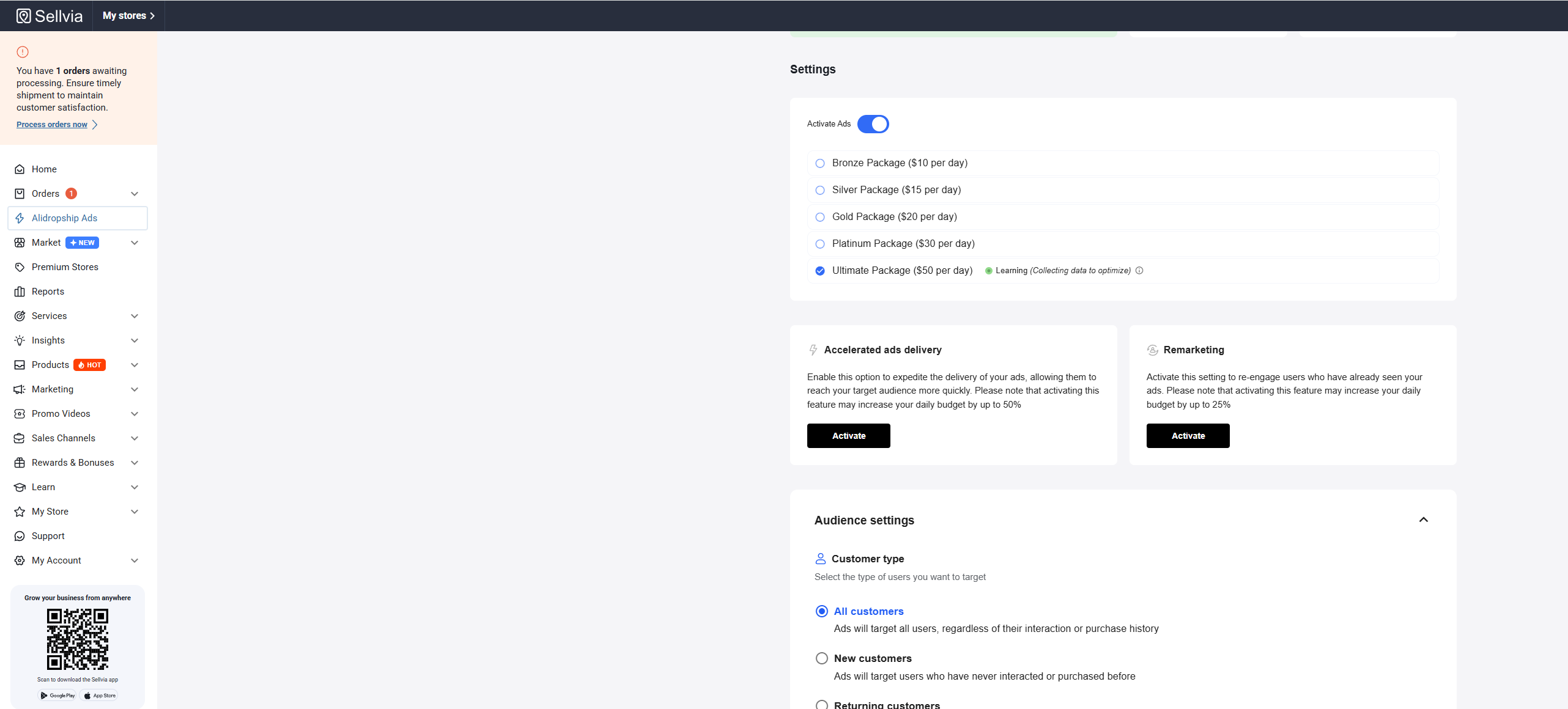
Sellvia pricing: $39/month subscription plus $10 to $50 per day on the built-in ad system. Total monthly spend for a beginner running consistent ads: $339 to $489 per month.
On paper Stan Store looks dramatically cheaper. $29 versus $489 is not a close comparison. But that comparison is deeply misleading if you don’t account for what’s missing from the Stan Store equation.
Stan Store charges no transaction fees and no monthly ad cost because it provides no traffic system. Every customer who buys from your Stan Store came from your audience - your TikTok followers, your Instagram audience, your email list, your YouTube subscribers. If you don’t have that audience you don’t have customers. And building that audience to a size where it generates real revenue takes most creators 12 to 24 months of consistent content creation.
So the honest cost comparison isn’t $29 versus $489. It’s $29 plus 18 months of content creation work versus $489 per month for a traffic system that starts working in weeks. Those are very different investments and which one makes sense depends entirely on what you’re starting with.
 Products - creating versus curating
This is the most fundamental difference between the two platforms and the one that determines whether either one is accessible to a beginner right now.
On Stan Store you sell products you create yourself. Your course. Your ebook. Your template pack. Your coaching program. Your community membership. If you don’t have a product - you have nothing to sell. Stan Store is a tool for creators who already have expertise, already have content, and already have an audience that trusts their recommendations. The platform is excellent for that specific person. It is not designed for someone who doesn’t yet have those things.
Creating quality digital products that people actually pay for is genuinely hard and genuinely time-consuming. A useful course requires scripting, recording, editing, and platform setup. An ebook requires research, writing, editing, and design. A template pack requires real design skills. Any of these done properly takes weeks to months before you have anything worth selling. And then you still have to build the audience to sell it to.
On Sellvia you sell from a pre-built catalog of professionally created digital products. You don’t create anything. You curate - pick the products that match your audience, focus your store around a clear category, and drive traffic through the built-in ad system. The time from signing up to having something worth selling is measured in hours not months.
The tradeoff is real. Your Sellvia products aren’t yours - the intellectual property belongs to Sellvia’s catalog, you don’t control pricing, and other Sellvia store owners have access to the same products. Your Stan Store products are entirely yours - you own them completely, you control everything, you build a brand around your specific expertise.
If you’re a creator with something original to sell - Stan Store gives you something Sellvia cannot. If you want to start earning commissions from digital products without spending months creating them first - Sellvia removes the barrier that stops most aspiring Stan Store sellers from ever launching.

 Traffic and audience - the comparison that decides everything
This is where Stan Store and Sellvia diverge most dramatically and where most beginners make the wrong choice because the marketing for both platforms doesn’t make this difference explicit.
Stan Store has no built-in traffic system. None. Zero. When you publish a product on Stan Store it doesn’t appear in any marketplace or search result. Nobody discovers your Stan Store by browsing Stan Store. Every single customer who buys from you clicked a link you shared from your own social media, your own email list, or your own content. Stan Store is literally a checkout layer sitting behind your existing audience. Without the audience it’s an empty checkout page.
This is why every successful Stan Store you’ve seen on social media belongs to a creator who already had tens of thousands of followers before they launched their store. The store didn’t build the audience. The audience enabled the store. Those are completely different things that the “I made $10k from my Stan Store” posts consistently blur together.
Sellvia’s built-in advertising system changes this equation entirely. You set a daily budget between $10 and $50, activate the campaign, and the system drives real paying customers to your store. You don’t need an existing social media following. You don’t need an email list. You don’t need to have been creating content for 18 months. The platform solves the traffic problem that makes Stan Store inaccessible to most beginners right now.
This isn’t a small difference. Traffic is the entire game in digital product selling. A beautiful store with great products and zero traffic makes zero sales. The platform that solves the traffic problem for you is providing something categorically more valuable than the platform that handles checkout and leaves traffic entirely to you.
 Where Stan Store genuinely wins
Fair is fair. Stan Store has real advantages that are worth naming honestly because this post only helps people if both sides get a real look.
Creator-native design. Stan Store is built specifically for the creator economy. The link-in-bio format integrates naturally with how creators already use social media. Adding a product is fast. The checkout experience is clean and familiar to social media audiences. If you already have a following and you want the path of least resistance from “I want to sell something” to “it’s for sale” - Stan Store delivers that efficiently.
Complete product ownership. Everything you sell on Stan Store belongs entirely to you. The intellectual property, the customer relationships, the brand equity. If you build a successful Stan Store you’re building an asset that compounds over time and belongs to you completely. Nothing is shared with other sellers. Nothing is controlled by a catalog you don’t own.
Membership and community features. Stan Store’s Creator Pro plan includes robust community and membership functionality that Sellvia doesn’t have. If your business model involves recurring revenue through memberships or ongoing community access - Stan Store’s toolset is genuinely more appropriate for that.
No transaction fees. At meaningful sales volume the absence of transaction fees matters. If you’re doing $5,000 per month in Stan Store sales you’re keeping significantly more per dollar than you would on platforms that take a percentage. That math improves as you scale.
These advantages are real. They matter enormously for the right person at the right stage. That person is a creator with an existing audience, original products, and a business model built around their personal brand. Most beginners asking this question are not that person yet.
 Ease of use - the practical starting experience
For a complete beginner with no prior experience this comparison goes decisively one way.
Stan Store setup takes about twenty minutes. Create account, set up your storefront, add your products, share the link in your social media bio. The platform is genuinely easy to use. The problem is what comes next. You’ve set up the store. Now you need customers. And getting customers requires an audience you’ve spent months or years building. The ease of setup ends the moment you realize nobody is coming.
Sellvia setup takes a few hours. Configure your store, select your product focus from the catalog, fund your Sellvia balance, activate the ad campaign. More steps but each step has a clear purpose. The end result is a store with active traffic coming to it. The setup is more involved because more infrastructure is being set up.
For a beginner the relevant question isn’t which platform is faster to get live. It’s which platform is more likely to produce a first sale within the first thirty days. On that question the built-in Sellvia Ads system gives a structural advantage to anyone starting without an existing audience.
The thread on why some stores never get their first sale covers the traffic problem in detail - it’s directly relevant to anyone considering Stan Store without an existing following: Why Some Sellvia Stores Never Get Their First Sale (And It's Almost Never What People Think) 🔍

 Who should actually choose which platform
This is the question the entire comparison is building toward. The honest answer is cleaner than most people expect once you understand what each platform actually assumes you’re starting with.
Choose Stan Store if you already have an established social media following that actively engages with your content. If you have 10,000 or more genuinely engaged followers on TikTok, Instagram, YouTube, or any other platform where people already look to you for advice or entertainment - Stan Store lets you monetize that existing relationship efficiently with zero transaction fees and complete product ownership. The platform was built for exactly this situation and it’s excellent at it.
Choose Stan Store if you’re a creator with original expertise and original content and the patience to build an audience over 12 to 24 months before expecting meaningful revenue. If you’re committed to the creator path - building a personal brand, growing a following, developing your own products - Stan Store gives you the infrastructure to monetize that journey properly once you’ve built the audience.
Choose Sellvia if you’re starting without an existing audience and you want to generate commissions from digital products without spending months creating them first. The built-in ad system solves the traffic problem that makes Stan Store inaccessible to most beginners today. The pre-built product catalog solves the creation problem. The $39 per month gets you a complete operating system for selling digital products rather than just a checkout layer behind an audience you don’t have yet.
Choose Sellvia if you want a concrete path from day one to first sale measured in weeks not months. The advertising system gives you a predictable lever - more budget equals more traffic equals more potential sales. That predictability is genuinely valuable when you’re learning and need to understand what’s working.
The honest pattern: Stan Store is the right tool for the second chapter of a creator business. Sellvia is the right tool for chapter one - when you need a system that works without requiring you to have already done 18 months of audience building before your first dollar.
Most people comparing these two platforms are in chapter one. For them the choice is usually clearer than the marketing of either platform suggests. 
 The honest bottom line
Stan Store is a checkout tool that becomes powerful when you already have an audience. Without the audience it’s an empty room with a great door.
Sellvia is a complete business platform that works without an existing audience. The traffic system is the product as much as the store itself.
Neither is objectively better. They’re solving different problems for people at different stages. The mistake is choosing based on which name you’ve seen more recently or which monthly fee looks lower - without accounting for the audience you need to make one of them actually work.
Know your starting point honestly. Choose the platform that meets you there.
Drop your experience below
Has anyone here tried Stan Store before coming to Sellvia - what made you switch? 
For Stan Store users reading this - how did you build the audience that makes your store work and how long did it actually take?
Has anyone tried running both at the same time - does that strategy even make sense?
And for anyone currently deciding between the two - what’s the specific thing making it hard to choose?
Honest experience from both sides welcome. The more specific the better. 
