Let me start with something uncomfortable.
The stores that never get their first sale are not unlucky. They’re not victims of a broken platform. And they’re almost never failing because Sellvia doesn’t work.
They’re failing for a small set of specific, predictable, fixable reasons that show up in the same patterns over and over. I’ve seen enough of these situations - on this forum, in conversations with other store owners, and in my own early mistakes - to be able to map them out with reasonable confidence.
This post is that map. Not to make anyone feel bad. But because understanding exactly why stores fail to get their first sale is the most direct path to not being one of them. 
 First - the wrong mental model that causes most of the problems
Before getting into specific failure modes there’s a root cause underneath almost all of them.
The wrong mental model.
Most people who never get their first sale came in with some version of this belief: “If I set up the store correctly and turn on the ads, sales will come.”
That belief is close to true but wrong in a way that matters enormously. The correct version is: “If I set up the right store for the right audience with the right products and give the ad system enough time and budget to find buyers - sales will come.”
The difference between those two sentences is where almost all the failure lives. Let’s break it down piece by piece.
 Reason #1 - The ad budget is too small to generate real data
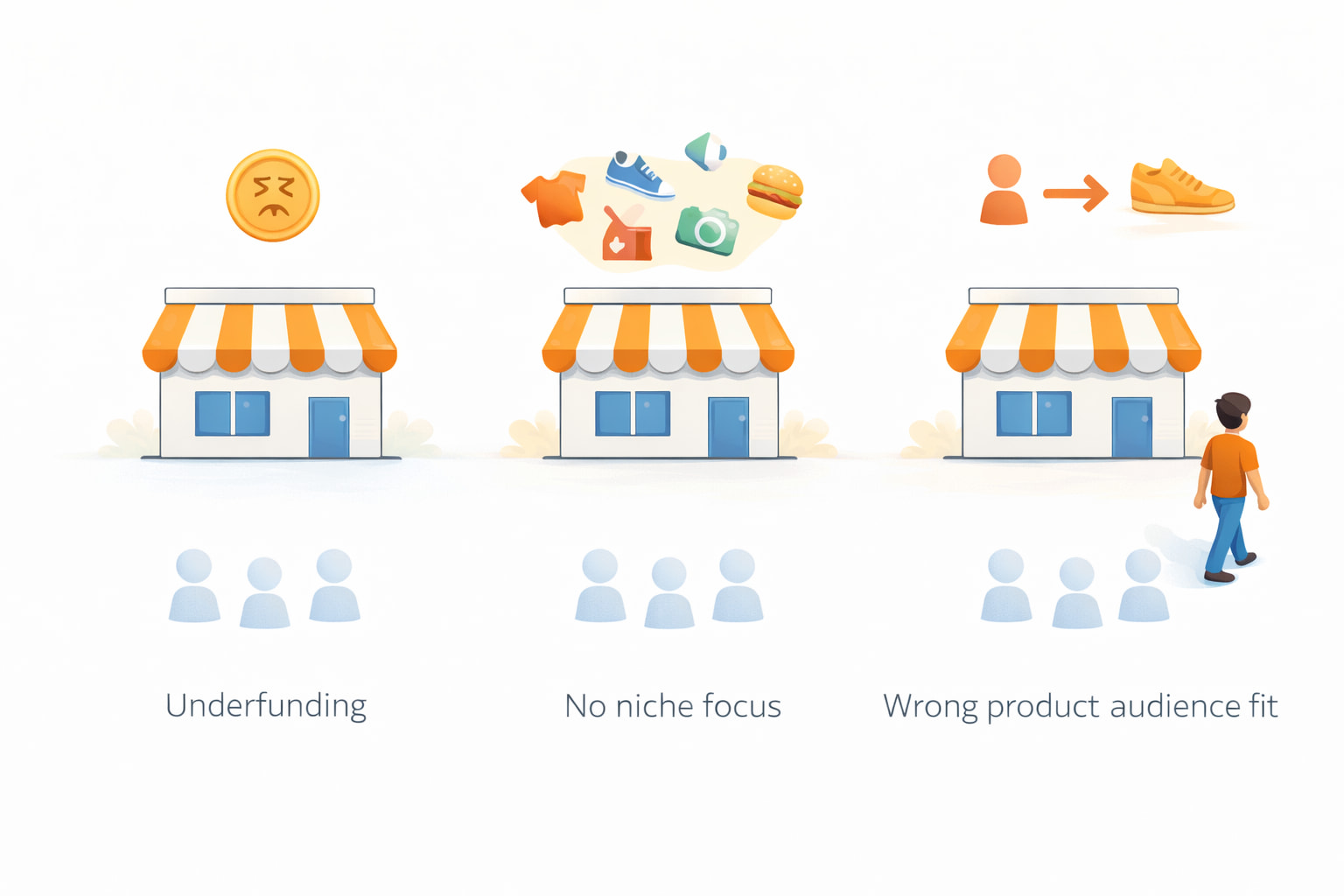
This is the most common reason stores never see a first sale and it’s also the most fixable.
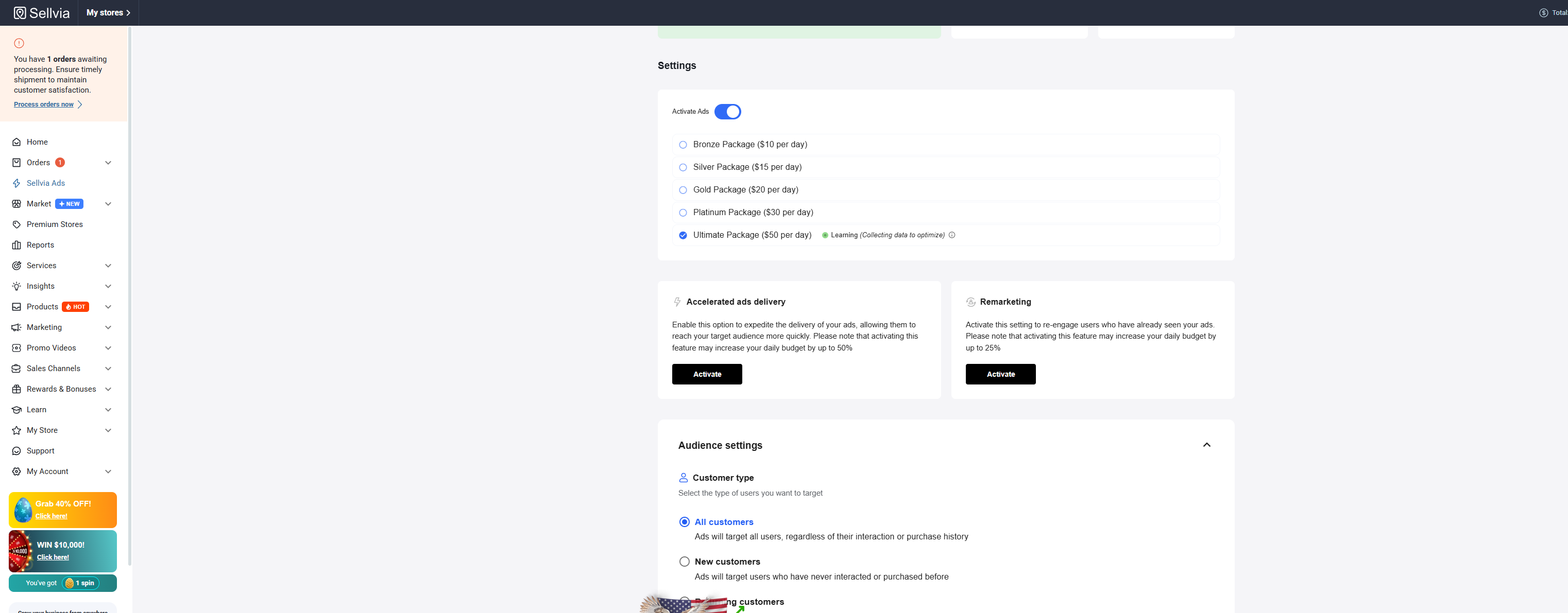
The Sellvia Ads system is a machine learning algorithm. It needs data to optimize - specifically it needs to see enough impressions, clicks, and ideally purchase events to understand who your buyers are and how to find more of them.
At $5/day the algorithm gets maybe 200-300 impressions before it has to make optimization decisions. That’s not enough data. At $10/day you’re getting enough for the system to start learning. At $15/day you’re in the zone where optimization actually happens at a meaningful pace.
What this looks like in practice:
Someone signs up, uses their $40 ad coupon over 8 days at $5/day, sees zero sales, concludes Sellvia doesn’t work. What actually happened: the algorithm never had enough budget to find buyers. The test was testing the wrong variable. They weren’t testing whether Sellvia works. They were testing whether $5/day is enough to generate sales. It isn’t. That’s not a Sellvia problem - it’s a budget problem.
The fix: Minimum $10/day. Ideally $15/day. Give it at least 14 days before drawing any conclusions. If you can’t sustain $10/day for 14 days - you don’t have enough budget to test the model properly yet. Save more before starting.
Reason #2 - The store has no coherent identity
Walk into a store that sells home organization guides, fitness courses, business templates, parenting ebooks, and financial planning tools all at the same time. Who is this store for?
Nobody can answer that question. And when nobody can answer that question in the first five seconds of landing on your store - they leave.
The stores that never get their first sale are overwhelmingly stores that tried to sell everything to everyone. The logic feels right - more products means more chances to sell something. The reality is the opposite. A store without a clear identity has no audience. An ad system driving traffic to a store with no clear identity is sending people to a place that makes no promise and therefore generates no trust.
What this looks like in practice:
Someone adds 50 products across six unrelated categories because they want to “cover all the bases.” The ad system sends traffic. People land, see no coherent theme, don’t understand what the store is about, and leave without buying. The store owner sees the traffic numbers going up and the sale count staying at zero and concludes the ads aren’t working. The ads are working. The store is the problem.
The fix: Pick one category. One specific audience. 8-12 products that make complete sense together. A visitor should be able to land on your store and immediately understand exactly who it’s for and what it offers. If they can’t - your store isn’t ready to convert traffic yet.
Reason #3 - The products don’t match the traffic intent
This is a subtler version of the identity problem and it causes just as many zero-sale stores.
Your ad system is driving a specific type of person to your store. That person clicked because something in the ad resonated with them - a headline, a visual, an implied promise. When they land on your store they’re looking for the fulfillment of that implied promise.
If your store is showing them something unrelated to what made them click - they leave. Not because they don’t buy things online. Not because the products are bad. Because there’s a disconnect between what they came for and what they found.
What this looks like in practice:
Your Sellvia Ads are optimized around financial stress and income building - which is the natural audience the platform drives traffic from. Your store is selling fitness and wellness guides. The person who clicked was thinking about money. Your store is talking about health. The conversation doesn’t match. No sale.
The fix: Match your product category to the audience your ad system is naturally reaching. Financial products, income building guides, and business resources tend to align naturally with the Sellvia Ads audience. Health and personal development are also strong. The closer the match between what the traffic source implies and what your store delivers - the higher your conversion rate.
Reason #4 - The store was never actually ready to convert
This one is harder to see because the store looks fine. Products are there. The layout is okay. But something in the experience is quietly killing conversions before they happen.
Slow mobile loading. Most of your traffic is on mobile. If your store takes more than 3-4 seconds to load on a phone - a significant percentage of visitors leave before seeing a single product. They don’t tell you this. They just disappear from your analytics as a bounce. You see the traffic. You don’t see the invisible wall that’s stopping it from converting.
Checkout friction. Something in the checkout flow is breaking the purchase. An unexpected shipping cost appearing at the last step. A payment method that doesn’t work on mobile. A checkout page that doesn’t load properly on certain browsers. These issues are invisible until you actually go through your own checkout process on your phone - which most store owners never do.
No trust signals. A first-time visitor has never heard of your store. They don’t know if it’s legitimate. If your store has no reviews, no social proof, no clear policies, no visible contact information - some percentage of people who would have bought simply don’t trust it enough to complete the purchase.
What this looks like in practice:
Traffic is coming in. Add-to-cart rate is decent - maybe 3-5% of visitors are adding products. But purchase completion rate is near zero. The visitor got interested enough to add to cart and then abandoned. That’s not a traffic problem. That’s a checkout or trust problem. And it will keep happening regardless of how much ad spend you throw at it.
The fix: Go through your own checkout on your phone right now. If anything feels clunky, slow, or confusing - fix it. Install Microsoft Clarity or Hotjar (both free) and watch session recordings of real visitors. You will see exactly where people are dropping off. It’s uncomfortable to watch and completely invaluable for diagnosing conversion problems.
Reason #5 - The store launched and then got abandoned
This one is painful to say because it reflects a pattern that’s more common than most people admit.
The store launches. Ads turn on. The first few days are quiet. The store owner checks the dashboard twice a day for three days, sees no sales, starts to lose confidence, checks less frequently, eventually stops checking at all. The ads keep running in the background spending money. The store keeps sitting there getting traffic that goes nowhere because nobody is managing it.
Active store management in the early stage doesn’t mean constant changes. It means showing up every day to look at the same three numbers - visitors, add-to-carts, conversions - and noticing whether they’re moving. It means catching a checkout issue before it costs you a week of lost sales. It means noticing that a particular product is getting lots of clicks but no add-to-carts and asking why.
The store that never gets its first sale is often not a store that failed. It’s a store that was abandoned before the first sale could happen.
The fix: Build a 20-minute daily routine. Check your numbers. Write them down. Notice the trend. Make one small observation per day about what the data is telling you. Do this every day for 30 days. The stores that develop this habit get their first sale. The ones that don’t often never do.
Reason #6 - The balance wasn’t funded and orders couldn’t be processed
This one is almost too mechanical to include but it happens often enough to deserve its own section.
Someone gets their first order. Maybe even their second. But their Sellvia balance is empty and they don’t notice the processing notification in time. The order window expires. The sale is lost. The commission is lost. From the outside it looks like “I had sales and still made nothing” - which is technically true but has a completely different cause than most people assume.
Some stores that “never get their first sale” actually got orders that couldn’t be processed because the balance wasn’t ready.
The fix: Fund your Sellvia balance before you turn on ads. $100-150 minimum. Set it to auto-process. Never think about this again.
Reason #7 - The testing window was too short
The ad algorithm needs time. Not days. Weeks.
Most people who never get their first sale gave up at the exact moment the system was starting to work. Week one is almost always quiet. The algorithm is learning your audience. It hasn’t found your buyers yet. Week two things start to move. Traffic quality improves. Add-to-carts start appearing. Week three the first sale usually comes for stores that have done the setup correctly.
The people who quit at day 8 will never know this. They’ll tell everyone Sellvia doesn’t work. And from their perspective it didn’t - because they never gave it long enough to work.
What the data actually shows:
The stores that report their first sale most commonly hit it between day 5 and day 21. That means stores that quit before day 21 are quitting before the most common first-sale window has even closed.
The fix: Decide in advance how long you’re giving this. Write it down. 30 days minimum with consistent ad spend. Not 30 days of checking the dashboard and worrying. 30 days of letting the system run while you make small, deliberate adjustments when the data suggests something specific needs to change.
Reason #8 - Everything was changed at once when nothing was working
Slow week. No sales. Anxiety builds. In one 48-hour window: changed all the products, changed the ad budget, changed the store layout, changed the featured category.
Now you have no idea what any of those changes did because you changed everything simultaneously. If sales improve - which of the five changes worked? If sales stay flat - which of the five changes caused it? You don’t know. You’ll never know. And you’ll probably do it again next slow week.
The stores that never get their first sale often aren’t stores where nothing worked. They’re stores where the owner changed too many things too fast and created noise that made it impossible to learn what actually worked.
The fix: One change at a time. One week minimum between changes. Write down every change with the date and the reason. When results shift - you’ll know why. This is the difference between learning and just generating activity.
 The honest pattern underneath all of these reasons
Looking at this list there’s one thing connecting almost every failure mode.
Impatience combined with insufficient information about what normal looks like.
If you knew that a quiet week one is normal - you wouldn’t panic and change everything.
If you knew that $5/day is too small to test anything - you wouldn’t conclude the platform doesn’t work after burning through your coupon.
If you knew that coherent niche focus matters more than product count - you wouldn’t load 50 products across six categories.
Every failure on this list is a knowledge problem before it’s a results problem. Which means this post - or something like it - read before you launch is worth more than any single tactical change you could make after launch.
The stores that get their first sale share one thing 
They gave the system what it needs to work.
Enough budget to generate data. A focused store that makes sense to the people landing on it. Products that match the traffic intent. A funded balance ready to process orders. A testing window long enough to see results. And enough patience to change one thing at a time when adjustments were needed.
None of that is complicated. All of it requires information that most beginners don’t have before they start. Which is exactly why threads like this one exist. 
Drop your experience below
Which reason on this list was your specific problem when you weren’t getting sales - and how did you figure it out? 
Is there a reason that isn’t on this list that killed your early momentum?
And for anyone currently at zero sales - how long have you been running and what does your current setup look like? Let the thread help diagnose it 
Specific situations get specific answers. The more detail you share the more useful the responses will be.